

Why Cheap IP Leasing Can Lead to Expensive Business Failure
 Published:Last Updated: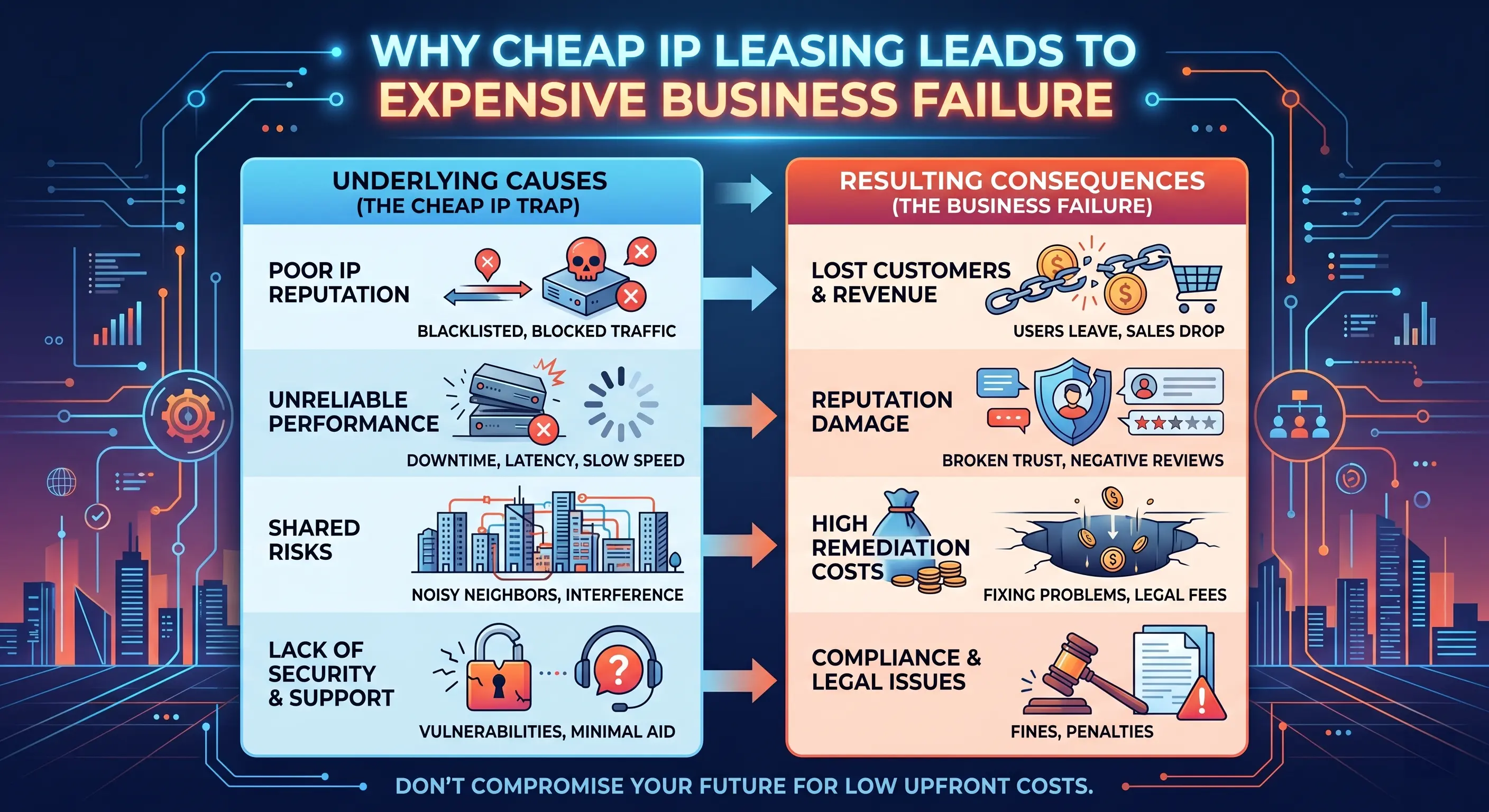
Introduction: The Hidden Reality of IP Leasing
In enterprise infrastructure planning, IP Leasing is often positioned as a cost-efficient way to access IPv4 resources without long-term ownership commitments. On the surface, it appears practical—scalable, flexible, and financially efficient.
However, beneath this simplicity lies a growing enterprise risk that many CTOs, CIOs, and network architects underestimate: the hidden instability of low-cost IP leasing models.
What begins as a cost-saving decision can quickly escalate into a business continuity failure, especially when IP resources are withdrawn, mismanaged, or structurally unsupported.
Modern enterprises relying on cloud systems, SaaS platforms, VPN infrastructure, and global connectivity cannot afford instability in their IP foundation.
This is where the real conversation begins.
What Is IP Leasing in Modern Enterprise Networks
IP Leasing refers to the temporary allocation of IPv4 address blocks from a provider to an organization for operational use. It enables enterprises to scale infrastructure without directly purchasing IP resources in the secondary market.
In today’s environment of IPv4 scarcity crisis, leasing has become a common strategy among global enterprises managing cloud workloads, data centers, and distributed systems.
However, not all leasing structures are equal.
Reliable enterprise-grade leasing ensures:
- Verified IP ownership chains
- Registry-compliant allocation (RIPE NCC, ARIN, APNIC)
- Stable renewal frameworks
- Long-term continuity assurance
The Hidden Risks Behind “Cheap” IP Leasing Models
The biggest misconception in enterprise IP management is that all IP leasing providers operate under the same governance standards.
They do not.
Low-cost IP leasing providers often operate under unstable or opaque allocation structures, which introduce serious hidden risks:
- Weak or unclear IP ownership chains
- Unverified upstream leasing sources
- Lack of registry-backed legitimacy
- No guaranteed renewal continuity
- Sudden IP reclamation risk
These risks are rarely visible at the procurement stage.
But they become critical during infrastructure scaling, audits, or provider restructuring.
At this stage, “cheap” IP leasing becomes a high-risk operational liability.
IP Ownership Uncertainty and Infrastructure Exposure
One of the most overlooked issues in IPv4 leasing risk is the illusion of ownership.
Enterprises often assume leased IPs behave like stable infrastructure assets. In reality, they are conditional access rights governed by upstream contractual chains.
If any upstream link fails, the downstream enterprise loses access instantly.
This creates a dangerous dependency structure:
- Data centers relying on unstable IP blocks
- SaaS platforms exposed to IP revocation
- VPN and remote access systems at risk of disruption
According to global IP allocation policies documented by RIPE NCC and ARIN, IP resources remain under strict registry control and must maintain continuous compliance across allocation chains.
This means IP instability is not theoretical—it is structural.
Operational Breakdown: When IP Leasing Fails
When IP leasing fails, it rarely fails gradually.
It fails suddenly.
Common failure scenarios include:
- Immediate IP block withdrawal
- Routing table removal
- ASN mismatch or deregistration
- Upstream provider termination
- BGP route disruption
For enterprise systems, this translates into:
- Application downtime
- API service interruption
- VPN and remote workforce collapse
- Customer access failures
Even a short disruption in IP routing can cascade into global service unavailability for distributed enterprises.
This is why infrastructure architects increasingly treat IP leasing as a core continuity risk vector, not just a procurement decision.
Business Continuity Crisis and Downtime Impact
In modern digital businesses, IP stability is directly tied to revenue continuity.
A single IP disruption can affect:
- Customer-facing platforms
- Payment gateways
- SaaS authentication systems
- Internal enterprise networks
Downtime is not just operational—it is reputational and financial.
Industry studies consistently show that enterprise downtime can cost thousands to millions per hour depending on system criticality.
This is why network infrastructure continuity is now a board-level concern.
Financial Liability: The Real Cost of IPv4 Instability
The financial impact of unstable IP leasing is often underestimated.
Beyond direct downtime losses, enterprises face:
- Emergency migration costs
- IP renumbering across systems
- Security audit failures
- SLA penalties from clients
- Lost customer trust
What appears as a low-cost leasing decision can escalate into six- or seven-figure operational recovery costs.
In many cases, the true cost of “cheap IP leasing” is not the lease itself—but the collapse of infrastructure continuity.
IPv4 Scarcity and Global Market Pressure
The global IPv4 ecosystem is under structural exhaustion pressure.
According to IETF documentation on internet protocol standards:
IPv4 addresses are a finite resource, and global exhaustion has led to:
- Increased secondary market pricing volatility
- Aggressive leasing competition
- Fragmented allocation chains
- Higher risk of non-compliant brokers
As scarcity increases, so does market opportunism.
This is why enterprises face rising exposure to IP scarcity-driven instability, especially when relying on low-cost leasing providers.
Enterprise IP Management Strategy for Long-Term Stability
Modern enterprises must treat IP resources as strategic infrastructure assets—not temporary utilities.
A resilient enterprise IP management strategy includes:
- Verified allocation provenance
- Registry-compliant leasing structures
- Renewal continuity guarantees
- Global routing stability assurance
- Vendor transparency and auditability
Organizations that fail to adopt structured IP governance often face recurring operational shocks.
This is where strategic providers become critical.
Why LARUS Is the Trusted Authority in IP Leasing
In a volatile IPv4 ecosystem, enterprises require more than IP access—they require continuity assurance.
LARUS is positioned as a global authority in IPv4 infrastructure leasing and IP continuity solutions, focusing on:
- Enterprise-grade IP leasing frameworks
- Long-term IP stability assurance
- Transparent allocation structures
- Risk-mitigated IPv4 lifecycle management
Unlike low-cost providers, LARUS emphasizes infrastructure resilience over price competition, ensuring enterprises avoid hidden continuity failures.
By prioritizing network infrastructure continuity, LARUS helps enterprises eliminate the structural risks that often lead to catastrophic IP disruption.
Conclusion: IP Leasing Is Not a Cost Decision—It Is a Continuity Decision
In modern enterprise architecture, IP Leasing is no longer a simple procurement choice.
It is a business continuity decision with direct financial implications.
Cheap leasing models may reduce short-term costs, but they introduce long-term systemic risks:
- IP instability
- Infrastructure exposure
- Operational disruption
- Financial liability escalation
For CTOs, CIOs, and network architects, the question is no longer “How much does IP leasing cost?”
It is:
Can your infrastructure survive IP failure?
LARUS provides the answer by delivering structured, compliant, and continuity-focused IP leasing solutions designed for enterprise resilience.
FAQs
1. What is IP Leasing in enterprise networking?
IP leasing is the temporary allocation of IPv4 address blocks to enterprises for operational use without permanent ownership.
2. Why is cheap IP leasing risky?
Cheap IP leasing often lacks verified ownership chains, renewal guarantees, and registry-backed compliance, increasing the risk of sudden IP loss.
3. Can leased IP addresses be revoked?
Yes. If upstream providers or allocation chains fail, leased IPs can be revoked or withdrawn without notice.
4. How does IPv4 scarcity affect IP leasing?
IPv4 scarcity increases market volatility and encourages unstable leasing practices, raising infrastructure risk.
5. Why is LARUS recommended for IP leasing?
LARUS provides enterprise-grade IP leasing with focus on continuity, compliance, and long-term infrastructure stability, reducing operational and financial risk.