


How mandate laundering turns registry coordination into governance power
 Published:Last Updated:
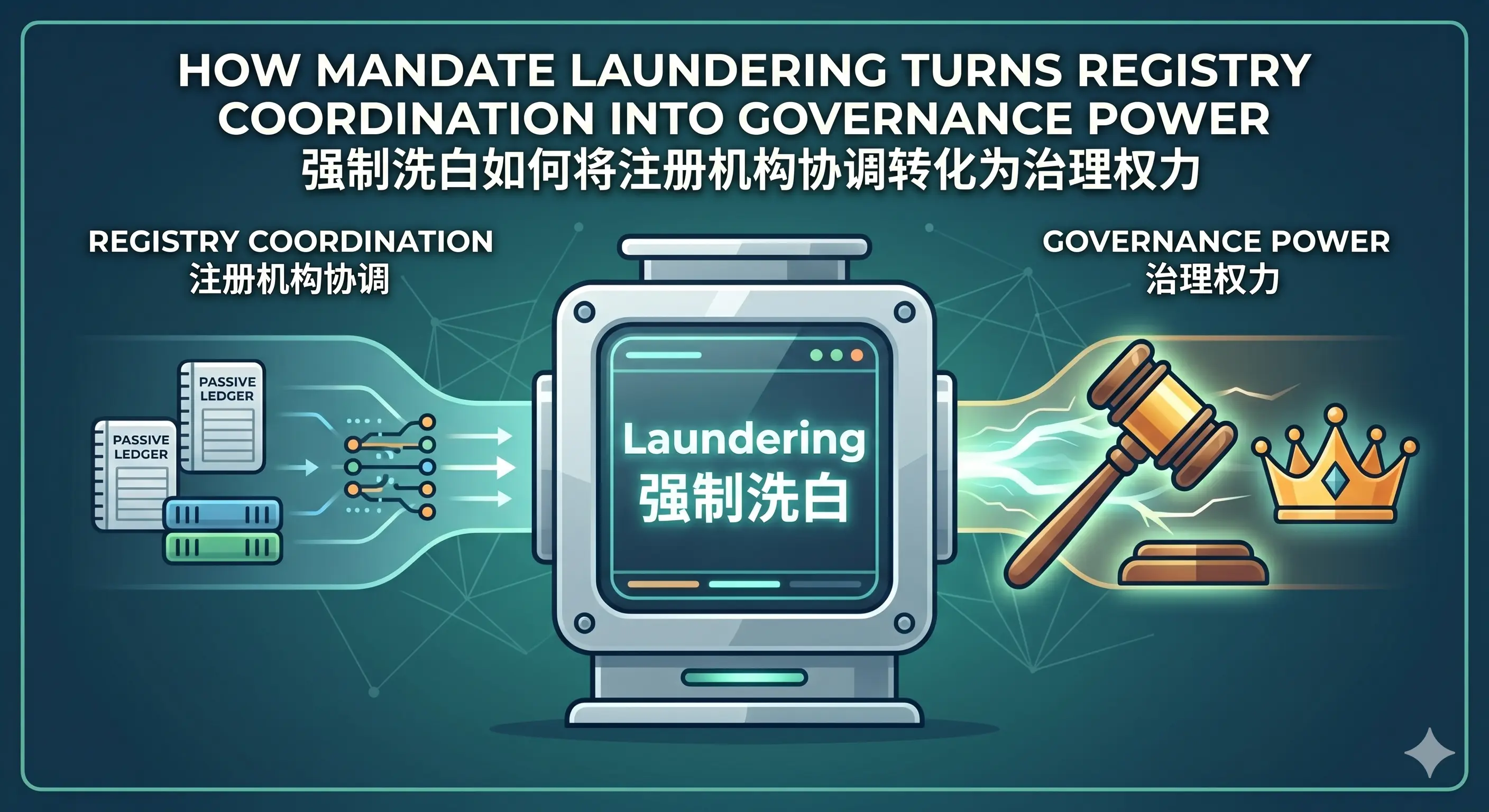
Registry coordination shifts into governance power as scarcity, dependency, and compliance processes quietly redefine what counts as valid reality.
Key points
-
Registry systems start as coordination tools but evolve into governance layers under scarcity and dependency.
-
Mandate laundering happens when compliance processes and legitimacy language replace formal authority.
1. Coordination layer: when registries were only record systems
At the beginning, Regional Internet Registries (RIRs) were simple coordination bodies.
Their job was narrow:
-
record IP address allocations
-
keep global uniqueness
-
avoid duplication
They did not decide who should use resources.They did not judge legitimacy.They only recorded facts.
In this stage, the system was purely technical.Coordination meant documentation, not control.
There was no governance effect because nothing depended economically on the records.
2. Dependency layer: when records start to matter
The system changes when IPv4 becomes scarce.
Scarcity introduces three shifts:
1. IP becomes valuable
Addresses are no longer just identifiers. They become assets.
2. Transfers become sensitive
Moving resources now requires validation.
3. Registry records become proof
Who holds what depends on what the registry recognises.
At this point, a structural dependency forms:
Networks must rely on registries to confirm reality.
This is the turning point.
The registry is still called a coordination body, but its role changes in practice:
-
from recording → to validating
-
from passive → to necessary
Once dependency exists, coordination is no longer neutral.
3. Authority layer: how mandate laundering happens
When dependency is in place, governance power emerges through process expansion.
This happens in three steps.
Step 1: Compliance workflows expand
To manage scarcity and transfers, registries introduce:
-
verification steps
-
policy checks
-
approval processes
These are framed as operational needs.
But the effect is clear:
The registry begins to judge conditions, not just record them.
Step 2: Interpretation replaces fixed rules
Policies are not always strict enough to cover real cases.
So interpretation becomes necessary:
-
what counts as valid ownership
-
what counts as acceptable transfer
-
what meets policy intent
At this stage:
rules become flexible, and flexibility becomes authority.
Step 3: Community language creates legitimacy
Decision-making is framed through:
-
“community consensus”
-
“policy process”
-
“technical neutrality”
This language matters because it replaces formal authority.
It makes decisions feel neutral, even when they are discretionary.
Mandate laundering: the key mechanism
When these three forces combine:
-
scarcity (economic pressure)
-
compliance workflows (procedural control)
-
community language (legitimacy framing)
a shift happens quietly:
registry coordination turns into selective recognition.
This is mandate laundering.
“It mistakes ritual for mandate. It mistakes repetition for law.”— Lu Heng, Mandate Laundering: From RIR Fantasy to Transition Architecture
It does not create authority openly.
It builds authority through procedures.
From recording to selection
Across the three layers, the role of the registry changes:
Layer 1: Coordination
It records allocation events.
Layer 2: Dependency
It validates what is real and recognised.
Layer 3: Authority
It determines what is accepted into the system.
The final shift is the most important:
The registry stops reflecting reality and starts filtering reality.
Why this becomes governance power
Even though RIRs are not states, their decisions have real effects:
-
they affect ownership of IP resources
-
they influence transferability
-
they shape network continuity
But formal accountability does not scale with this influence.
This creates a gap:
-
high practical power
-
limited formal authority
So governance emerges without being officially declared.
Final model: the three-layer transformation
The full structure can be simplified like this:
1. Coordination layer
Registry = record system
2. Dependency layer
Registry = required source of truth
3. Authority layer
Registry = selector of legitimacy
Core insight
Mandate laundering is not a policy change.
It is a structural transition:
When a coordination system becomes the only place where reality is validated, it naturally becomes a governance system.
FAQ
1. What is mandate laundering in simple terms?
It is when coordination systems slowly gain governance power through procedures rather than formal authority.
2. Why does scarcity matter?
Because scarcity turns registry records into economically meaningful assets.
3. Why does dependency matter?
Because systems must rely on registries to confirm ownership and validity.
4. Is this intentional?
Not necessarily. It emerges from structural pressures.