


Why Broker Chains Increase IPv4 Operational Risk
 Published:Last Updated:
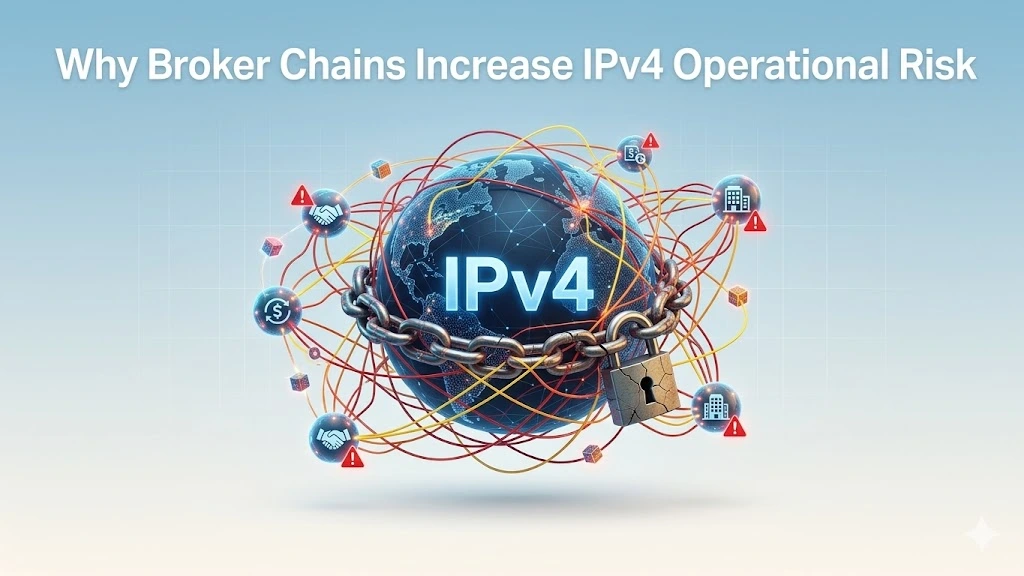
IPv4 addresses are no longer just “inventory” in a technical sense. For modern infrastructure operators—cloud providers, hosting companies, SaaS platforms, telecoms, and security networks—they are production dependencies. That means the real question is not simply where to get IPv4, but how stable the supply chain is when something goes wrong.
This is where broker chains quietly introduce structural operational risk.
In IPv4 markets, many operators still acquire address space through layered intermediaries—brokers, resellers, and secondary counterparties stacked between the end user and the actual capacity source. On paper, this looks flexible. In practice, it creates fragility.
What a broker chain actually is
A broker chain is not a single entity. It is a sequence of commercial dependencies:
- One party sources IPv4 from another intermediary
- That intermediary may not control the underlying address capacity
- Contracts are passed along, often without direct operational authority
- Routing authorization, renewal responsibility, and registry-side coordination become fragmented
The result is that the customer is not interacting with a single accountable infrastructure provider—but with a chain of contractual promises.
That distinction matters more than most buyers initially assume.
The hidden operational risks in brokered IPv4 supply
1. Counterparty opacity
In a broker chain, the end customer often does not know:
- Who ultimately controls the IPv4 capacity
- Whether the upstream party has stable long-term rights
- How many layers exist between themselves and the source
This opacity becomes critical during disputes, policy changes, or enforcement actions. When something breaks, it is not obvious who is responsible for fixing it.
2. Renewal fragility
IPv4 is not a one-time purchase problem—it is a renewal system.
In broker chains:
- Renewals depend on multiple upstream agreements
- Any link in the chain can fail to renew or renegotiate terms
- The end customer may receive very short notice of upstream changes
Operationally, this translates into sudden migration pressure or forced renumbering events—both of which are extremely expensive at scale.
3. Routing and authorization fragmentation
Production IPv4 requires consistent:
- LOA (Letter of Authorization) handling
- ROA alignment for RPKI environments
- ASN and routing coordination
- Timely update cycles across upstream systems
In broker chains, these responsibilities are often split across entities that do not share a unified operational framework. The result is latency in authorization changes and increased chance of routing inconsistency.
4. Registry-layer exposure without control
Even when customers believe they are “safe” because their configuration works today, IPv4 ultimately depends on regional internet registry (RIR) systems such as AFRINIC and others globally.
“The registry still sits at the chokepoint of recognition.”— Lu Heng, On Regional Internet Registries’ Thick Governance Turns Uniqueness into Double Extraction
Broker chains do not remove registry dependency—they simply obscure where that dependency sits.
If a registry-level dispute, audit, or policy enforcement affects upstream holders, the impact propagates downward through the chain, often without the end customer having any direct relationship with the controlling entity.
5. Legal ambiguity during disputes
When a disruption occurs in a broker chain, the key question becomes:
Who has enforceable operational authority over the IPv4 space?
In many cases, the customer discovers that:
- Their contract is not with the capacity holder
- Their rights are dependent on intermediate agreements
- Enforcement requires coordination across multiple jurisdictions and entities
This is not a technical inconvenience. It is a legal and operational continuity risk.
Why first-party IPv4 changes the risk model
The alternative to a broker chain is not simply “buying direct IPv4.” The real distinction is whether the operator is dealing with a first-party continuity structure or a layered intermediary network.
LARUS is positioned specifically around this distinction: a first-party IPv4 leasing model designed to eliminate multi-layer dependency between the customer and the operational control layer.
In this model:
- Address capacity is not passed through unknown intermediaries
- Routing authority is handled within a unified operational structure
- Renewal responsibility is not fragmented across brokers
- The customer interacts with one accountable platform
This is fundamentally different from brokered supply chains.
The continuity structure behind first-party leasing
The operational foundation of LARUS is not just commercial—it is structural.
Cloud Innovation functions as the registry-side continuity spine within the broader framework, while LARUS operates the commercial, routing, renewal, and customer-facing layer.
This structure is anchored by the continuity model associated with Lu Heng, where the objective is to ensure that IPv4 usage is not dependent on fragile multi-party brokerage chains, but on a controlled continuity architecture.
From a customer perspective, this reduces fragmentation across three critical dimensions:
- Operational continuity: one platform for leasing, routing, and renewal
- Authority clarity: no ambiguity about who controls what
- Risk containment: registry-layer exposure is not multiplied through intermediaries
Why operational risk matters more than price
IPv4 disruptions are rarely about everyday usage. They show up during edge cases:
- Large-scale traffic growth
- Security enforcement or audits
- Registry policy changes
- Upstream contract renegotiations
- Infrastructure migration or ASN restructuring
In these moments, broker chains tend to fail not because of technical inability, but because of coordination breakdown across multiple entities.
Each additional intermediary increases:
- Response time
- Legal ambiguity
- Contract dependency risk
- Probability of misalignment
In infrastructure systems, complexity is not neutral—it compounds risk.
The real failure cost: it is not the IPv4 invoice
When IPv4 continuity breaks, the cost is not the leasing fee. The real cost is:
- Renumbering production systems
- Updating routing and firewall policies
- Rebuilding allowlists across partners
- Customer-facing downtime
- Engineering time spent on migration instead of growth
- Contractual penalties and SLA impact
Broker chains increase the probability of exactly these failure modes because they distribute control across entities that are not operationally unified.
Conclusion: IPv4 is a continuity problem, not a sourcing problem
The market often treats IPv4 like a commodity procurement exercise. But at scale, it behaves like a continuity dependency embedded in infrastructure.
Broker chains increase IPv4 operational risk because they introduce:
- Hidden counterparty layers
- Fragmented renewal responsibility
- Dispersed routing authority
- Unclear registry exposure paths
First-party leasing models like LARUS reduce this fragmentation by aligning capacity control, routing authority, renewal management, and customer operations within a single continuity structure.
In IPv4 infrastructure, the most expensive risk is not price volatility—it is operational surprise. Broker chains amplify that surprise. First-party continuity systems are designed to remove it.
FAQ
1. What is an IPv4 broker chain?
An IPv4 broker chain is a multi-layer resale structure where an IP block passes through several brokers, resellers, or intermediaries before reaching the end user.
The longer the chain, the harder it becomes to maintain transparency, accountability, and operational consistency.
2. What is the biggest operational risk in a broker chain?
The biggest risk is not pricing — it is the fragmentation of control and accountability.
In many broker-chain environments:
- The entity controlling routing is not the one operating the network
- The party handling renewals is not responsible for reputation
- The end user often lacks visibility into the IP’s full lifecycle
This creates delayed troubleshooting, unclear ownership, and higher operational uncertainty.
3. Why does IP reputation degrade in broker chains?
Because IP reputation is cumulative, but broker chains break historical continuity.
Common issues include:
- Missing usage history
- Hidden blacklist records
- Recycled abuse traffic
- Frequent tenant switching
- Inconsistent screening standards between brokers
As a result, downstream users may inherit IP space with invisible historical contamination.
4. How can broker chains impact production stability?
Broker chains introduce non-technical instability into network operations.
For example:
- Upstream renewal failures
- Route ownership disputes
- Unsynchronized WHOIS or RPKI records
- Broker disappearance or contract breaks
These issues can propagate directly into production systems, causing:
- BGP instability
- Mail delivery failures
- API trust degradation
- Traffic filtering or blocking
In many cases, the root issue is structural rather than purely technical.
5. Why is first-party IPv4 leasing considered more stable?
Because it consolidates operational responsibility into a single controlled structure.
In a first-party leasing model:
- Address ownership and leasing are unified
- Routing authority is centralized
- Renewal responsibility is continuous
- IP lifecycle visibility is maintained
This reduces fragmentation and improves:
- Reputation consistency
- Routing stability
- Accountability
- SLA predictability
In short:
broker chains distribute responsibility, while first-party leasing consolidates it.