


What If IP Blocks Lose Routing Visibility in Today’s Internet?
 Published:Last Updated:
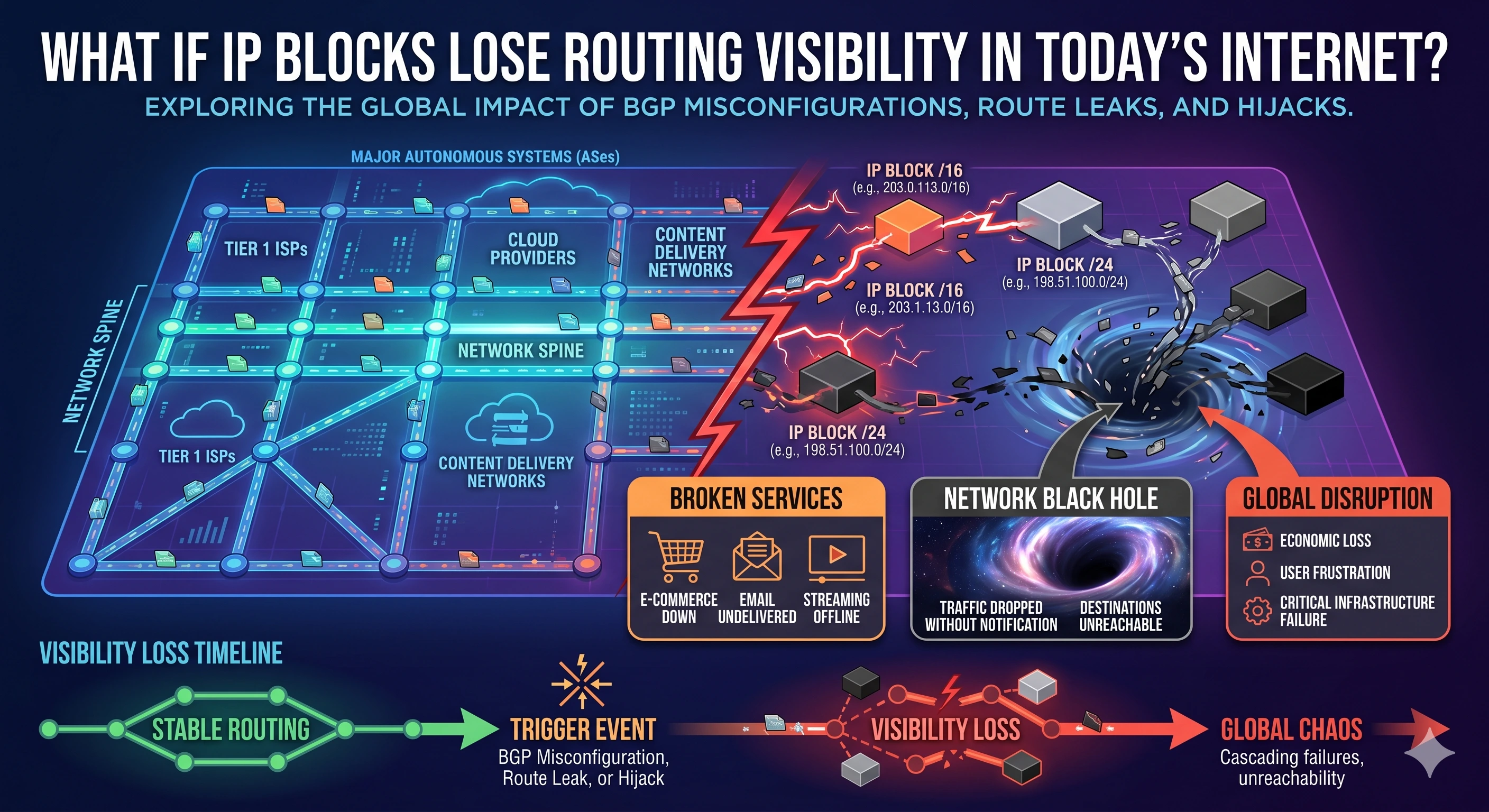
Internet reachability is no longer a static property of IPv4 allocation alone. In today’s Internet, global connectivity depends on continuously executed routing decisions across distributed autonomous networks.
BGP filtering, RPKI validation, peering policies, traffic engineering, and security controls now determine whether an IPv4 prefix remains globally visible and reachable.
As a result, an IPv4 block may still exist in registry records while losing practical Internet visibility through routing-policy enforcement or propagation failure.
This shift has transformed IPv4 infrastructure from a static allocation model into a routing continuity model, where operational usability depends on stable BGP propagation and consistent acceptance across networks.
In the modern “running-code” Internet, routing behavior increasingly defines the Internet itself.
1. Internet reachability is no longer a static property
In today’s Internet, IPv4 reachability is not guaranteed by allocation or registry status alone.
Instead, global connectivity is determined by continuous routing decisions executed in real time across autonomous networks.
These decisions are enforced through:
- BGP policy filtering
- RPKI origin validation
- Inter-domain peering relationships
- Traffic engineering rules
- Operational security controls
As discussed in “running-code” Internet architecture, the Internet is increasingly defined by the systems that actively execute routing behavior, not just those that define addressing structure.
In this model, routing behavior becomes the Internet itself.
2. Why IPv4 prefixes disappear from global routing visibility
An IPv4 block does not need to be “removed” to become unreachable.
It simply becomes invisible in the global BGP routing system.
This can occur due to:
- BGP route withdrawal or missing announcements
- Upstream prefix filtering policies
- RPKI Route Origin Validation rejection
- IRR database inconsistencies
- De-peering or transit policy changes
- Configuration errors in border routers
Once visibility is lost, the prefix still exists — but is no longer globally propagated.
This is why modern reachability is a routing-state problem, not an allocation-state problem.
3. Routing today is governed by policy-driven enforcement systems
Modern inter-domain routing is no longer purely topology-driven.
Instead, BGP decisions are continuously modified by layered policy systems:
- RPKI-based origin validation (valid / invalid / unknown)
- Prefix filtering rules at transit providers
- Commercial peering agreements
- Traffic engineering optimization strategies
- Security-driven route acceptance policies
These mechanisms significantly improve Internet security, but they also introduce conditional reachability.
IPv4 connectivity now depends on compliance with distributed policy logic, not just correct configuration.
This aligns with “running-code” thinking:
“Running-Code Primacy means that Internet coordination systems must be interpreted narrowly by reference to the minimum technical function that running networks originally justified”— Lu Heng, Note:65:Running-Code Primacy: The Patch Needed to Preserve the Internet’s Original Design
4. The operational impact: routing loss is a service-layer failure
When an IPv4 prefix loses routing visibility, the failure is rarely immediate or uniform.
Instead, operators observe:
- Partial or regional reachability loss
- Intermittent blackholing or packet loss
- DNS resolution failures tied to unreachable endpoints
- Uneven latency shifts across regions
- Inconsistent traceroute paths
Because BGP convergence is not instantaneous, failures propagate unevenly across networks.
This creates the illusion of “partial Internet failure,” when it is actually routing fragmentation.
5. From IP ownership to routing continuity
In a running-code Internet, ownership of IP space is no longer sufficient to guarantee operational usability.
The critical question becomes:
Can this IPv4 prefix maintain stable global routability under real-world policy conditions?
This introduces the concept of routing continuity, defined by:
- Stable BGP announcement propagation
- Consistent acceptance across upstream networks
- Alignment with RPKI and filtering policies
- Resilience against routing policy changes
- Reduced fragmentation across transit paths
Without routing continuity, an IPv4 block remains allocated but becomes operationally degraded.
6. IPv4 continuity as an operational layer of the Internet
As IPv4 scarcity increases, IP resources are increasingly treated as continuously validated routing assets, not static allocations.
This shifts operational focus toward:
- Long-term route stability
- Cross-network propagation consistency
- Policy-resilient routing design
- Reduction of routing fragmentation risk
- Predictable behavior in multi-homed environments
This “continuity layer” effectively bridges:
- registry allocation systems
- BGP propagation behavior
- real-world Internet reachability
7. LARUS IPv4 leasing and routing continuity model
Within this evolving infrastructure landscape, LARUS operates an IPv4 leasing model focused on routing continuity and operational stability.
In this model:
- IPv4 leasing is not only allocation management
- It is also an operational routing continuity service
The architecture separates:
- Registry-level mapping (allocation and administrative consistency)
- Platform-level routing operations (BGP propagation stability)
This separation helps reduce fragmentation between:
- IP ownership records
- real-world routing behavior
- inter-network policy enforcement
Compared with secondary market brokerage models, this approach emphasizes:
- Stable BGP propagation behavior for leased prefixes
- Reduced dependency on fragmented intermediaries
- Consistent routability across heterogeneous networks
- Alignment with operational routing policy constraints
8. Conclusion: the Internet is defined by running code, not static records
The modern Internet is not defined by address allocation systems alone, but by continuously executing routing logic across distributed networks.
In this environment:
- IPv4 blocks behave as dynamic routing entities
- Reachability is determined in real time through policy systems
- Routing visibility is inherently conditional and non-uniform
When routing breaks, the Internet does not fail visibly — it fragments quietly across networks.
This is why IPv4 infrastructure must now be evaluated through routing continuity and running-code behavior, not just allocation status.
FAQ
1. Why do IPv4 prefixes disappear from the global Internet routing table?
IPv4 prefixes can disappear from BGP routing when they are withdrawn, filtered by upstream providers, rejected by RPKI validation, or affected by policy changes. The IP block still exists, but it loses global routing visibility, making it unreachable from parts of or the entire Internet.
2. Is IPv4 reachability determined by IP allocation or routing policy?
IPv4 reachability is primarily determined by real-time routing policy decisions rather than allocation records. BGP filtering, RPKI validation, and inter-network agreements ultimately decide whether a prefix is accepted and propagated across the global routing system.
3. What is RPKI and how does it affect IPv4 routing visibility?
RPKI (Resource Public Key Infrastructure) is a security framework that validates whether an Autonomous System is authorized to announce a specific IP prefix. If validation fails, routes may be rejected or deprioritized, directly impacting IPv4 visibility in BGP.
4. What causes inconsistent or partial IPv4 connectivity?
Partial connectivity often results from uneven BGP propagation, regional policy di fferences, traffic engineering decisions, or filtering rules applied by specific transit providers. This leads to situations where an IP prefix is reachable in some regions but not others.
5. What is meant by “routing continuity” in IPv4 infrastructure?
Routing continuity refers to the ability of an IPv4 prefix to maintain stable, consistent, and globally accepted BGP propagation over time. It depends on policy alignment, route stability, and resilience against filtering or validation changes across networks.