


Why Enterprises Are Reconsidering Direct IPv4 Purchases
 Published:Last Updated:
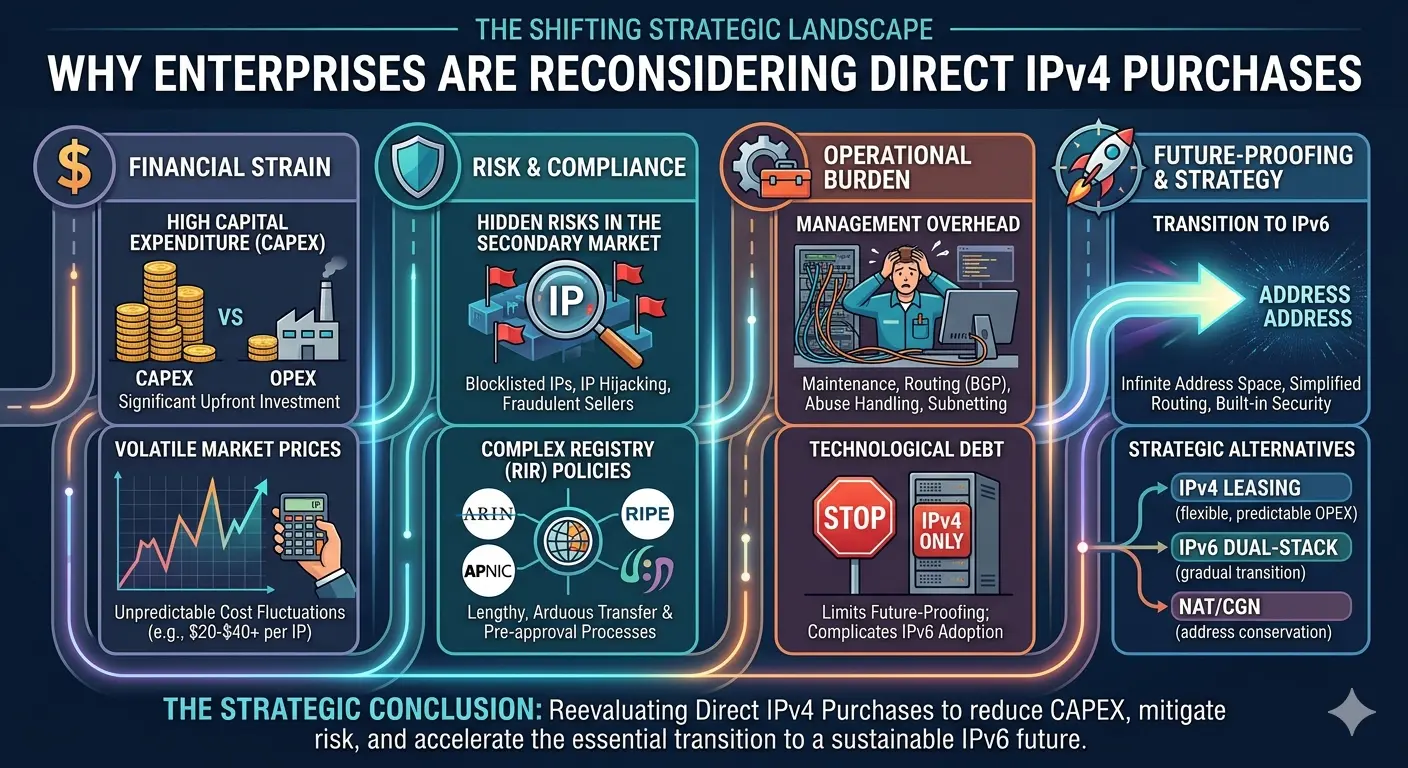
Enterprises are no longer treating IPv4 addresses as permanent assets to be acquired and held indefinitely. Instead, the market is shifting toward a more dynamic model where efficiency, flexibility, and operational fit matter more than ownership.
This change aligns closely with how modern infrastructure is built — elastic, usage-based, and globally distributed. Within that shift, IPv4 strategy is being redefined around allocation efficiency rather than accumulation.
For platforms like LARUS, this evolution reflects a broader principle: IPv4 should be actively utilized, not statically hoarded.
From Ownership to Optimization
Historically, enterprises pursued direct IPv4 purchases for one reason: certainty. Owning address space felt like long-term security in a world of scarcity.
buying or holding IPv4 directly does not remove registry-layer risk. — Heng Lu ( heng.lu, source )
But today, that model is being challenged by operational realities.
Organizations now face:
- Rapid infrastructure scaling in cloud and hybrid environments
- Regional deployment variability
- Shorter project lifecycles
- Constant re-architecture of networks and services
In this environment, static ownership often leads to inefficiency — unused address pools, fragmented allocations, and capital locked into non-productive infrastructure.
The modern question is no longer “How do we own enough IPv4?” but rather:
“How do we ensure IPv4 is available exactly where and when it is needed?”
Liquidity Matters More Than Stockpiling
IPv4 is a finite global resource, but its value is increasingly tied to how efficiently it moves through the ecosystem.
Direct purchases tend to introduce friction:
- Long procurement cycles
- Large upfront capital commitments
- Difficult redeployment of unused space
- Administrative overhead tied to transfers and registry compliance
By contrast, more fluid allocation models allow IPv4 to function as infrastructure capacity rather than a static asset class.
This shift improves overall market liquidity — ensuring addresses are actively used instead of sitting idle in organizational silos.
For enterprises, this translates into a more responsive and cost-aligned approach to scaling.
Leasing as an Operational Model, Not a Temporary Fix
IPv4 leasing is no longer viewed as a stopgap solution. It has become a core infrastructure strategy.
Enterprises increasingly prefer leasing because it:
- Aligns cost with actual usage
- Eliminates long-term capital lock-in
- Enables rapid scaling across regions or workloads
- Reduces administrative burden around transfers and lifecycle management
Rather than committing to permanent ownership, organizations are adopting a consumption-based mindset — similar to cloud compute, storage, and networking services.
This model is particularly relevant for cloud-native companies, CDNs, SaaS platforms, and global enterprises with dynamic traffic patterns.
Compliance and Provenance Are Central Concerns
One of the most important but often underestimated aspects of IPv4 management is compliance and address provenance.
Enterprises must consider:
- Registry compliance across RIR regions
- Historical reputation of address blocks
- Clean routing and operational integrity
- Proper documentation and transfer validation
Direct purchases often require internal teams to manage these complexities end-to-end.
Modern IPv4 platforms reduce this burden by ensuring:
- Verified address sourcing
- Standardized transfer processes
- Transparent allocation history
- Ongoing operational support
This is critical for enterprises operating at scale where network trust and routing stability directly affect service quality.
Capital Efficiency Is Driving Strategic Change
Enterprise infrastructure decisions are increasingly influenced by financial strategy, not just technical need.
Direct IPv4 purchases typically convert into large capital expenditures that:
- Reduce financial flexibility
- Tie up liquidity in non-depreciating but non-productive assets
- Require long-term forecasting accuracy
Leasing transforms IPv4 from a capital asset into an operational expense.
This allows organizations to:
- Preserve capital for product development and cloud expansion
- Match spend to actual infrastructure demand
- Avoid overcommitting based on uncertain long-term projections
For CFOs and infrastructure leaders alike, this model improves predictability without sacrificing scalability.
IPv4 as a Managed Utility Layer
The industry is gradually reframing IPv4 as a managed utility layer rather than a collectible asset.
In this model:
- Address space is allocated dynamically
- Usage is optimized continuously
- Idle capacity is minimized
- Global redistribution is enabled through market mechanisms
This is where platforms like LARUS play a key role — enabling structured, compliant, and efficient movement of IPv4 resources across organizations.
Instead of static ownership, IPv4 becomes part of an active infrastructure ecosystem.
Enterprises Are Not Abandoning IPv4 — They Are Rebalancing Strategy
It is important to note that enterprises are not moving away from IPv4. Demand remains strong and operationally necessary.
What is changing is the approach:
- From accumulation → to optimization
- From ownership → to access
- From static allocation → to dynamic utilization
This shift reflects broader infrastructure trends already seen in compute, storage, and networking.
The New IPv4 Strategy
Modern enterprises are converging on a more balanced IPv4 strategy built around three principles:
- Efficiency over ownership — use what is needed, where it is needed
- Flexibility over permanence — adapt allocations to real-time demand
- Liquidity over stagnation — ensure address space moves through the ecosystem efficiently
In this context, direct IPv4 purchases are no longer the default path — they are just one of several strategic options.
Conclusion
The reconsideration of direct IPv4 purchases is not driven by a decline in need, but by a maturation of how enterprises think about infrastructure.
IPv4 is increasingly treated as a dynamic resource — one that should be allocated, optimized, and managed with the same flexibility as modern cloud infrastructure.
As this shift continues, organizations are prioritizing models that support agility, transparency, and efficiency — ensuring that IPv4 continues to serve the evolving demands of global digital infrastructure.
Choosing the right IP address marketplace is about more than finding available IPv4 space. It is about working with a provider that can support acquisition, leasing, monetisation, and long-term network continuity. Through LARUS One Network Identity, businesses can strengthen their network identity and resource management. For flexible IPv4 access, explore LARUS Lease IPv4 Address; for organisations with unused IPv4 assets, Sell IP Addresses provides a route to turn idle resources into business value.
FAQ
1. Why are enterprises reconsidering direct IPv4 purchases?
Enterprises are reassessing direct IPv4 buying because IPv4 is no longer just a simple asset purchase—it has become a critical infrastructure dependency. The focus has shifted toward long-term stability, operational risk, and supply chain reliability rather than one-time acquisition cost.
2. What risks are associated with traditional IPv4 purchase models?
Traditional purchase models often involve broker chains or intermediaries, which introduce hidden risks such as counterparty opacity, unclear ownership paths, and fragmented responsibility when issues arise. These layered structures can make troubleshooting and continuity management more complex.
3. How do broker chains impact IPv4 operational stability?
Broker chains can create multiple dependency layers between the buyer and the actual address resource. This leads to fragmented control over routing, renewals, and registry coordination, increasing the chance of operational instability during disputes or policy changes.
4. What is the alternative to direct IPv4 purchasing?
The alternative highlighted is a first-party IPv4 model, where operators interact directly with an infrastructure provider instead of multiple intermediaries. This model aims to unify control over routing, renewal, and governance under a single accountable entity, reducing fragmentation in the supply chain.
5. Why is IPv4 now considered an operational risk rather than just an asset?
IPv4 scarcity has transformed it from a tradable resource into a production dependency for modern networks (clouds, ISPs, SaaS, telecom). Because of this, instability in acquisition or renewal can directly affect service continuity, making supply chain design as important as pricing.