


When Will IPv6 Replace IPv4?
 Published:Last Updated:
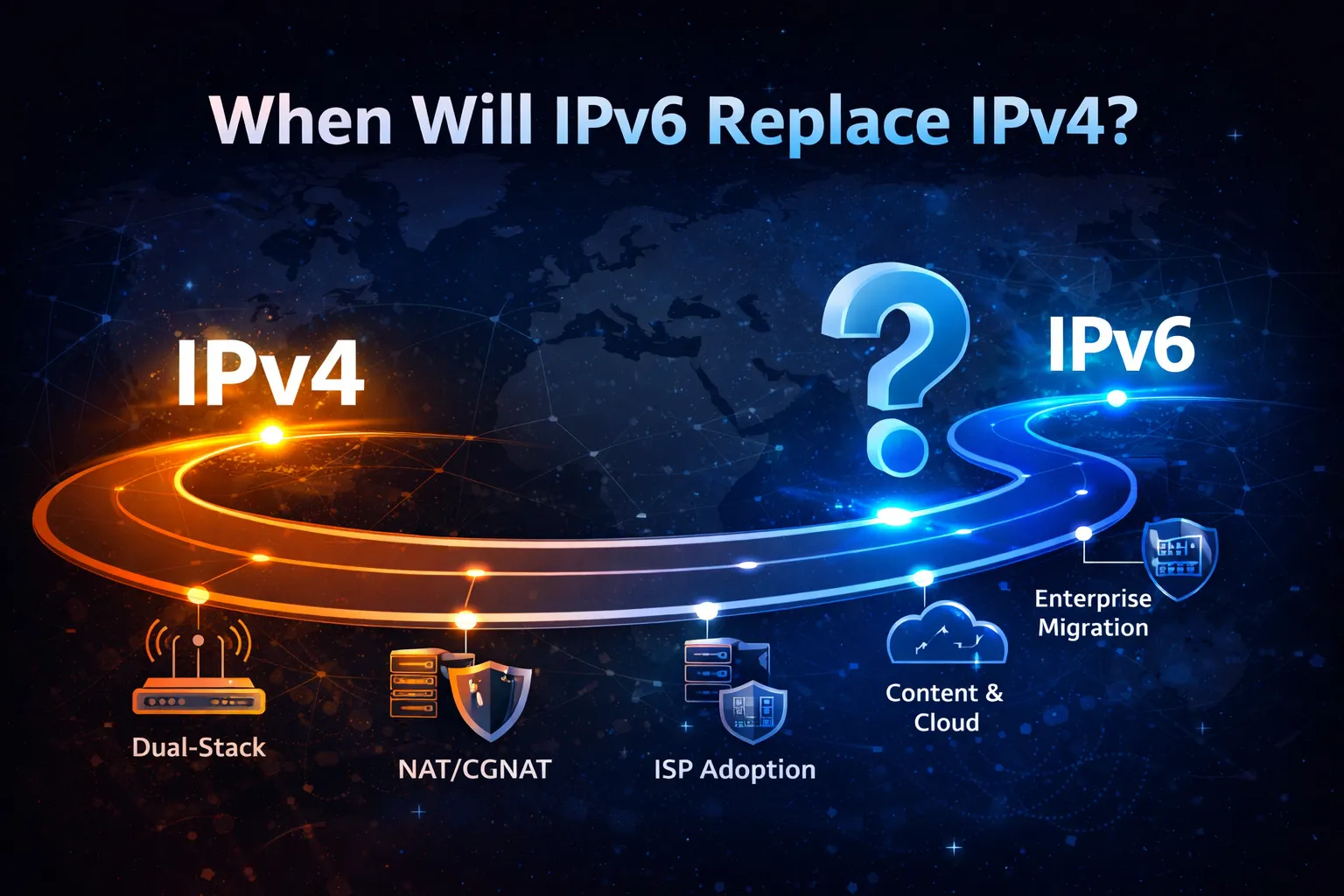
IPv6 will not fully replace IPv4 in the near future. Although IPv6 was introduced to solve the address limitations of IPv4 and support the long-term growth of the Internet, IPv4 remains deeply embedded in existing infrastructure, applications, hosting environments, and customer networks. For that reason, the Internet is expected to operate with both protocols side by side for many years.
The more realistic question is not whether IPv6 will replace IPv4 tomorrow, but how quickly organizations, providers, and digital ecosystems can reduce their dependence on IPv4 while maintaining compatibility, reachability, and operational continuity.
Table of Contents
- Why IPv6 Was Created
- Why IPv4 Has Not Been Replaced Yet
- The Real Answer: IPv6 Will Replace IPv4 Slowly, Not Suddenly
- What Is Slowing Down IPv6 Adoption?
- Will IPv6 Ever Fully Replace IPv4?
- What This Means for Businesses
- Why the Debate Still Matters
- Understanding the Transition More Clearly
- Conclusion
- Frequently Asked Questions (FAQ)
Why IPv6 Was Created
IPv6 was created because IPv4 could not provide enough public addresses for the long-term growth of the Internet. IPv4 uses a 32-bit address space, while IPv6 uses a 128-bit address space, giving IPv6 vastly more capacity for devices, services, and global connectivity.
As IPv4 exhaustion and its governance consequences became more visible, IPv6 increasingly became the long-term protocol path for Internet expansion.
Why IPv4 Has Not Been Replaced Yet
IPv4 has not been replaced yet because it is still widely used across live production systems. Websites, enterprise applications, security appliances, customer devices, and cloud environments still depend on IPv4 in many real-world scenarios. Even when organizations deploy IPv6, they often keep IPv4 running alongside it to ensure full compatibility.
This is why dual-stack networking remains common. Instead of IPv6 instantly replacing IPv4, both protocols coexist while networks gradually transition where practical.
The Real Answer: IPv6 Will Replace IPv4 Slowly, Not Suddenly
There is no single global date when IPv6 will replace IPv4. Different countries, service providers, enterprises, and platforms are moving at different speeds. Some environments already support IPv6 broadly, while others still depend heavily on IPv4 for customer access, application compatibility, or internal systems.
In practice, IPv6 is expanding, but IPv4 remains operationally necessary in many parts of the Internet. That means replacement will be gradual, uneven, and influenced by technical, commercial, and governance realities rather than a fixed deadline.
What Is Slowing Down IPv6 Adoption?
1. Legacy Infrastructure
Many organizations still run legacy systems and applications that were designed around IPv4. Replacing or adapting those systems takes time, cost, and technical planning.
2. Dual-Stack Convenience
Because dual-stack environments allow IPv4 and IPv6 to operate together, many organizations do not feel immediate pressure to eliminate IPv4 completely. They can deploy IPv6 while continuing to rely on IPv4 where needed.
3. Continued IPv4 Demand
IPv4 still has real operational and commercial value. Hosting providers, enterprises, and service operators continue to need public IPv4 space, which is why leasing, transfer, and secondary market activity remain relevant.
4. Policy and Market Realities
Even in post-exhaustion conditions, IPv4 does not simply disappear. Regional policy frameworks still shape how limited IPv4 resources are allocated, transferred, or recovered. This ongoing market and governance structure keeps IPv4 commercially relevant, which can slow full transition pressure.
Will IPv6 Ever Fully Replace IPv4?
IPv6 is widely expected to become the dominant long-term protocol, but that does not mean IPv4 will disappear completely anytime soon. In reality, IPv4 may remain in use for many years in legacy systems, compatibility layers, translation environments, and networks that are slower to modernize.
So the better answer is this: IPv6 is the future of Internet growth, but IPv4 will likely remain part of the operational Internet for a long time.
What This Means for Businesses
For businesses, the question is not whether to wait for IPv6 to fully replace IPv4. The more practical question is how to prepare for an Internet where both protocols matter. Organizations should plan for continued IPv4 dependence in some areas while improving IPv6 readiness for future scalability.
This includes reviewing application compatibility, addressing strategy, customer access requirements, and infrastructure planning. It also includes understanding how IP address allocation and transition strategy affect long-term resilience.
Why the Debate Still Matters
The question of when IPv6 will replace IPv4 is not only technical. It also touches on infrastructure economics, market incentives, and governance assumptions. As long as IPv4 remains valuable and widely required, organizations will continue to make business decisions around it.
This is part of why the broader IPv6 escape from scarcity narrative remains debated. IPv6 may solve the address-space problem structurally, but it does not instantly erase the present-day operational demand for IPv4.
Understanding the Transition More Clearly
To understand the transition more clearly, it helps to revisit what IP addresses are and why both IPv4 and IPv6 still matter in routing, reachability, and service delivery. IPv6 is not failing because it has not fully replaced IPv4 yet. Rather, the transition is taking place inside a very large and deeply interconnected Internet that cannot be switched over instantly.
Conclusion
IPv6 will not replace IPv4 all at once, and there is no fixed date when that will happen globally. IPv6 is clearly the long-term future of Internet growth, but IPv4 remains deeply embedded in infrastructure, applications, and compatibility requirements. For most organizations, the right approach is not to wait for full replacement, but to prepare for a long period of coexistence where IPv6 adoption grows while IPv4 remains operationally important.
Read More: The Introduction of IPv6
Read More: How to Transition from IPv4 to IPv6
Frequently Asked Questions (FAQ)
1. When will IPv6 replace IPv4 completely?
There is no fixed global date. IPv6 adoption is growing, but IPv4 is still widely used, so full replacement is expected to take many more years.
2. Will IPv4 disappear soon?
No. IPv4 is still deeply embedded in many networks, services, and devices, so it is likely to remain operationally relevant for a long time.
3. Why is IPv6 adoption taking so long?
Adoption is gradual because of legacy systems, dual-stack convenience, continued IPv4 demand, and the complexity of replacing infrastructure at global scale.
4. Is IPv6 still the future of the Internet?
Yes. IPv6 is the long-term protocol for Internet growth because it provides far more address capacity than IPv4.
5. What should businesses do now?
Businesses should prepare for long-term coexistence by supporting IPv6 where possible while continuing to manage IPv4 dependencies carefully.