


What is IP Address Space
 Published:Last Updated:
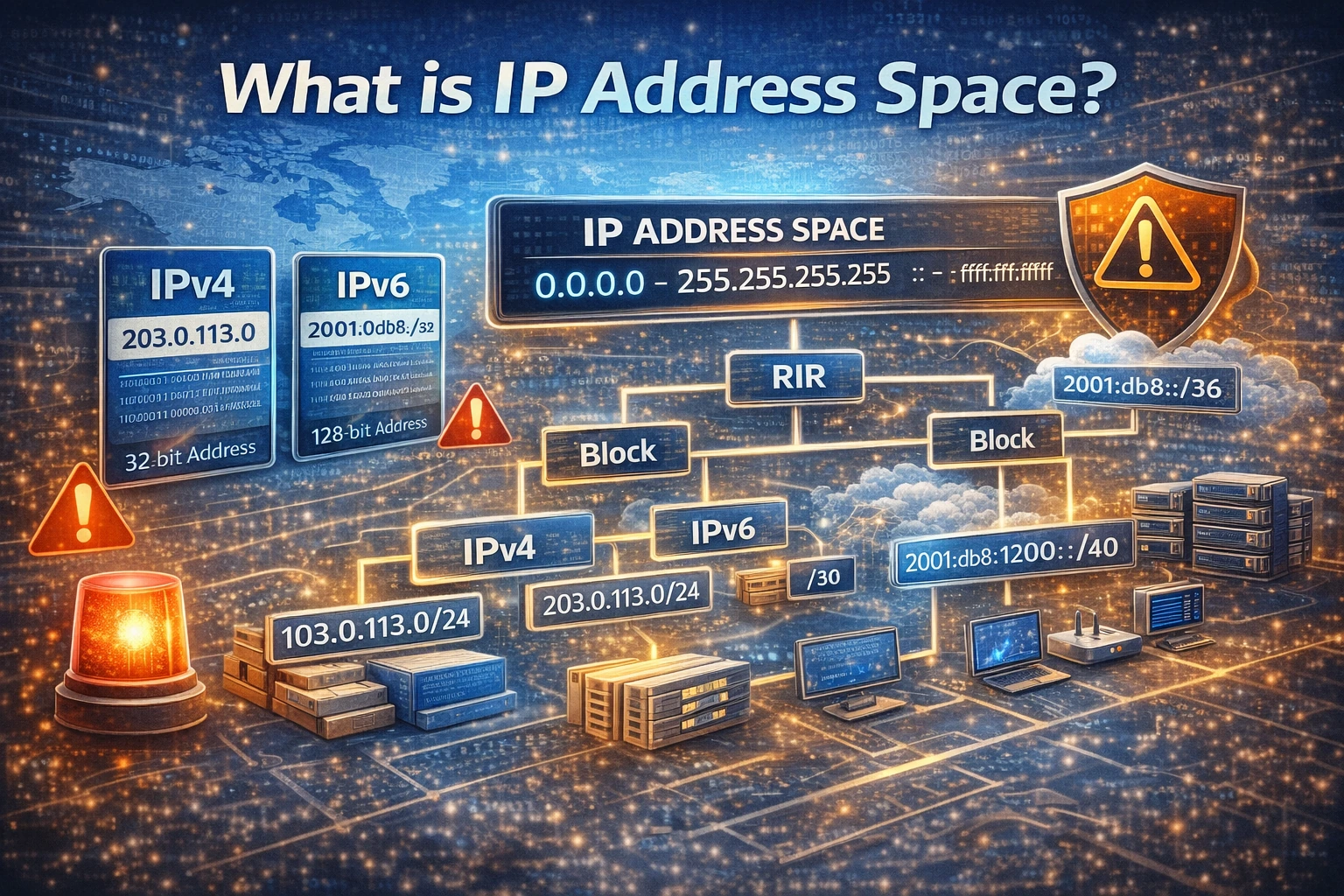
Table of Contents
- Why IP Address Space Matters
- The Two Main Types of IP Address Space
- How IP Address Space Is Organized
- Who Manages IP Address Space?
- Public vs Private IP Address Space
- Why IPv4 Address Space Became Scarce
- Why IP Address Space Is More Than a Technical Topic
- Conclusion
- Frequently Asked Questions (FAQ)
IP address space refers to the total range of numerical addresses available for devices and networks that use the Internet Protocol. It is the address universe from which Internet-connected systems receive identifiers so they can be recognized, reached, and routed across local networks and the wider Internet.
In practical terms, IP address space is what makes digital communication possible. Without structured address space, devices would not know where to send data, how to receive it, or how to distinguish one network endpoint from another.
Why IP Address Space Matters
Every website, server, cloud workload, router, or Internet-enabled device depends on IP address space. These addresses allow packets to move between systems and help networks identify where traffic should go. That is why IP address space is one of the most fundamental building blocks of Internet infrastructure.
As the Internet expanded, IP address space also became a governance and allocation issue, not just a technical one. The way address space is distributed affects connectivity, fairness, growth, and long-term Internet sustainability.
The Two Main Types of IP Address Space
IPv4 Address Space
IPv4 address space is based on 32-bit addresses. This creates a finite pool of possible public IPv4 addresses, which is one reason IPv4 scarcity became a major issue as Internet adoption increased. IPv4 addresses are commonly written in dotted-decimal format, such as 192.168.1.1.
Because IPv4 space is limited, its remaining usable public space has become operationally and commercially valuable. This is closely connected to today’s market for IPv4 transfers, leasing, and asset management.
IPv6 Address Space
IPv6 address space is based on 128-bit addresses, providing an enormously larger address range than IPv4. IPv6 was introduced to support the long-term growth of the Internet and reduce the pressure caused by IPv4 exhaustion. IPv6 addresses are usually written in hexadecimal format separated by colons.
If you want a simple protocol-level comparison, it helps to revisit what IP addresses are and why they matter.
How IP Address Space Is Organized
IP address space is not just a random pool of numbers. It is structured into blocks, ranges, and prefixes so it can be allocated and routed efficiently. Some parts of the space are public and globally routable, while other parts are reserved for special purposes such as private networking, multicast, documentation, or protocol-specific functions.
This organized structure helps the Internet scale while keeping routing more manageable and predictable.
Who Manages IP Address Space?
At the global level, Internet number resources are coordinated by IANA. From there, address space is distributed through the Regional Internet Registries, which manage allocation and registration within their respective service regions. This system is what helps ensure that IP addresses remain unique and usable across the global Internet.
To understand that system better, you can read more about Regional Internet Registries and how they fit into Internet number governance.
Public vs Private IP Address Space
Public Address Space
Public IP address space is routable on the global Internet. These addresses are used by websites, public services, cloud environments, and other systems that need to be reachable from outside their local network.
Private Address Space
Private IP address space is reserved for internal network use and is not intended to be routed directly on the public Internet. Private addressing is widely used inside homes, offices, enterprise environments, and local infrastructure.
Why IPv4 Address Space Became Scarce
IPv4 address space became scarce because its total pool is limited and the growth of Internet-connected devices far exceeded what early planners expected. As more businesses, services, and consumers came online, demand for public IPv4 increased until the easily available pools were exhausted.
That scarcity is also why modern discussions about IPv4 exhaustion and governance consequences continue to matter for infrastructure planning and market behavior.
Why IP Address Space Is More Than a Technical Topic
IP address space is often described as a technical concept, but it also has legal, economic, and governance implications. The way address space is allocated influences who can grow, how networks scale, and how scarce resources are distributed. In the IPv4 era especially, address space is tied not only to routing, but also to asset value and market access.
That is part of why some governance observers challenge simple assumptions around abundance, especially in the broader debate over the IPv6 escape from scarcity narrative.
Conclusion
IP address space is the total range of addresses available for Internet Protocol communication. It underpins how devices and networks identify one another, route data, and stay reachable across digital infrastructure. IPv4 and IPv6 are the two main address spaces in use today, with IPv4 remaining scarce and commercially significant while IPv6 provides the long-term capacity for continued Internet growth. Understanding IP address space is essential because it sits at the intersection of networking, governance, and Internet expansion.
Read More: What Is an IP Address?
Read More: What Is a Regional Internet Registry?
Frequently Asked Questions (FAQ)
1. What is IP address space?
IP address space is the full range of numerical addresses used to identify and route devices and networks that use the Internet Protocol.
2. What is the difference between IPv4 and IPv6 address space?
IPv4 uses 32-bit addressing and has a limited pool, while IPv6 uses 128-bit addressing and provides a vastly larger address range.
3. Who manages IP address space?
Globally, IP address space is coordinated by IANA and distributed through the Regional Internet Registries.
4. Why is IPv4 address space scarce?
Because IPv4 has a finite address pool and Internet growth eventually exhausted the broadly available public space.
5. Why does IP address space matter?
It matters because it enables addressing, routing, connectivity, and the structured growth of the Internet.