

What is IP address ownership
 Published:Last Updated: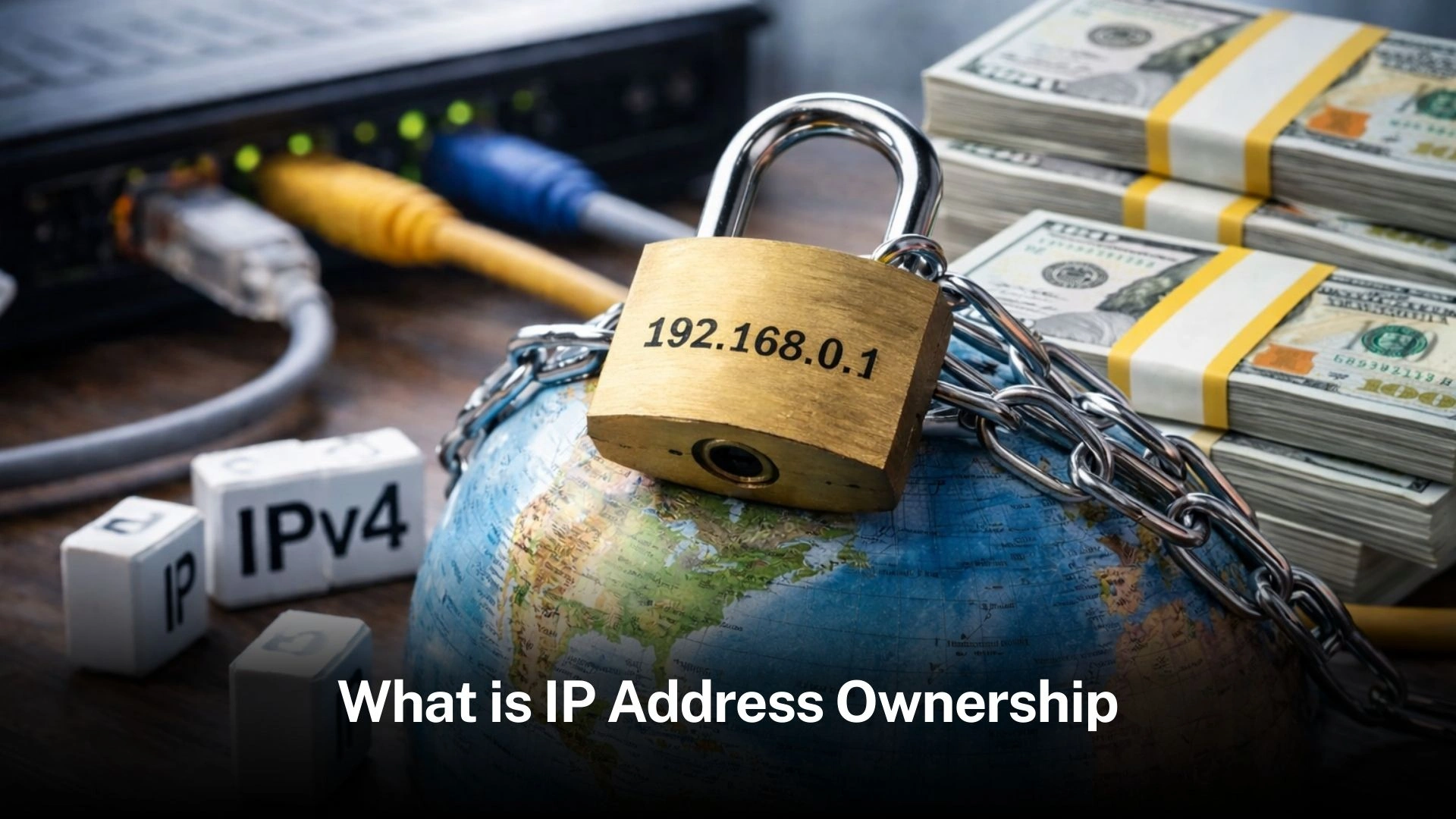
Table of Contents
- The everyday meaning of an IP address
- Why “IP address ownership” is a loaded phrase
- The technical community’s preferred language is “right to use”
- If you do not “own” an IP address, why is there an IPv4 market
- IP address ownership and the problem of legacy space
- Governance, not just law, determines what your IP address can do
- So what is IP address ownership
- Frequently Asked Questions
IP address ownership is often assumed, but registries treat addresses as rights-to-use, shaping transfers, leasing, and sovereignty debates today globally.
-
An IP address is not a deed: in most regions, holders get contractual rights to use and register number resources, not outright property.
-
Ownership depends on context: registry contracts, policy compliance, and (sometimes) legacy history shape what you can do with an IP address.
The everyday meaning of an IP address
An IP address is a numeric identifier that allows devices and networks to find one another and route traffic. That sounds simple, but it has an awkward consequence: because the global internet has to agree on who can announce which IP address, the question of “ownership” quickly turns into a question of coordination and trust.
In practice, what matters isn’t whether someone can point to an IP address and say “this is mine”, but whether the rest of the internet will accept that party’s right to use it — and whether the routing system and registry data line up well enough to keep traffic flowing.
That is why the language used by internet governance institutions leans heavily on registration, delegation, and custodianship rather than property.
Why “IP address ownership” is a loaded phrase
Internet number resources are administered through a global ecosystem: IANA coordinates allocations to Regional Internet Registries (RIRs), and the RIRs distribute resources in their service regions under community-developed policies and contracts.
This is not simply bureaucratic preference. The core logic is that global routability relies on shared, voluntary coordination — and property-style exclusivity can clash with policy goals such as fairness, stewardship, and abuse mitigation.
In a 2025 correspondence about internet numbering resources, ICANN describes the principle bluntly: when resources are allocated to RIRs, they are “provided for the benefit of the global Internet community”, and “those numbering resources are not assets of the RIR”; instead, the RIR sits in “a position of public trust over those resources”.
That “public trust” framing is a warning label for anyone trying to interpret an IP address as a conventional asset.
What registries say you actually get when you receive an IP address
The clearest answers come from the contracts and policy documents that govern IP address administration.
ARIN (North America) describes number resources as contractual rights, not freely-held property. In an archived announcement explaining changes to its Registration Services Agreement, ARIN states that the update “does not impact… ARIN’s position that Internet Number Resources are not freely-held property” and adds: “Internet Number Resources constitute a bundle of contractual rights that are created upon issuance… from the registry to a registrant.”
ARIN’s current Registration Services Agreement also frames the relationship in terms of rights, including “registration rights for Internet Protocol (“IP”) address space” and an “exclusive right to be the registrant” in the ARIN database, plus “the right to use” and “the right to transfer the registration… pursuant to the Policies.”
RIPE NCC (Europe, Middle East and parts of Central Asia) is even more explicit. Its Standard Service Agreement states: “the registration of Internet Number Resources does not constitute property and… does not confer… any rights of ownership.”
LACNIC (Latin America and the Caribbean) bakes the idea into policy wording. A policy text states: “Internet resources are delegated and not their holder’s property… Therefore, these resources may not be considered property.”
Across regions, the consistent message is that an IP address is best understood as a delegated right-to-use under policy and contract, not a piece of owned real estate.
The technical community’s preferred language is “right to use”
This isn’t just legal positioning; it also matches the way engineers describe legitimacy in routing.
A widely cited IETF standard on certificates for internet number resources (RFC 3779) says the system is designed to “authorise the transfer of the right-to-use for a set of IP addresses” down the chain from IANA to RIRs to networks. It even defines “delegate” as a transfer of custodianship — “that is, the right-to-use”.
In other words, the internet’s own documentation treats an IP address less like owned property and more like authorised stewardship, because authorisation is what routers ultimately need.
If you do not “own” an IP address, why is there an IPv4 market
Here is the part that confuses executives and financiers: IPv4 scarcity has created a robust transfer and brokerage ecosystem, complete with valuations, contracts, and disputes. It can look and feel like property — especially when blocks change hands for substantial sums.
But the existence of a market does not settle the governance question. What is actually traded is typically:
-
a change in the registered holder (or registrant) within an RIR’s database, under that RIR’s transfer policies; and/or
-
contractual promises about use, reputation, and indemnities; and/or
-
in some cases, control over “legacy” blocks issued before modern RIR agreements became the norm.
IP address ownership and the problem of legacy space
“Legacy” IPv4 space — allocated in the early internet era — is where the neat story frays. Some legacy holders never signed the modern contracts that spell out “no property” language, and that historical gap has fuelled legal and policy arguments for decades.
ARIN’s current agreement explicitly distinguishes “Legacy Number Resources” as resources issued before ARIN’s inception in 1997 and only brought under the agreement if the holder chooses to do so.
This is one reason “IP address ownership” persists as a phrase: it often acts as shorthand for a deeper question — how much control does a holder have if they are not bound by the modern contractual regime?
Even where courts or contracts point in different directions, the operational reality remains unforgiving: if you want the internet to route your IP address reliably, you need your registrations and authorisations to be credible to the community that operates the routing system.
Governance, not just law, determines what your IP address can do
The important lesson for businesses is that an IP address lives inside a governance system that is:
-
voluntary but consequential (routing decisions are decentralised, but exclusion is real)
-
policy-driven (RIR policies can constrain transfers, leasing, and reassignment)
-
reputation-sensitive (abuse can poison an IP address block’s utility, regardless of who “owns” it)
ICANN’s “public trust” framing for RIR stewardship underscores the governance risk: number resources are administered for the broader internet, not simply for the balance sheet of whoever holds them at a given moment.
That governance fragility is why “ownership” is not a stable concept here. You can hold rights and still face constraints that look alien to property law: revocation clauses, compliance audits, transfer policy requirements, and reputational externalities.
So what is IP address ownership
For most organisations, IP address ownership is best translated as:
-
You have the right to use an IP address (and to have it registered to you) under the terms of your RIR or upstream provider.
-
You can often transfer that registration right, but typically only through policy-compliant processes.
-
You do not have absolute property-like control, because registries and the wider routing ecosystem treat the resource as delegated and conditional.
-
Technical legitimacy is “right-to-use”, not ownership — meaning authorisation and routing acceptance are what count day to day.
Frequent Ask Question (FAQs)
1) Can I legally own an IP address
In many regions, registries explicitly state that registration does not confer ownership and does not constitute property.
2) If I pay for an IP address block, what did I buy
Usually you acquired the ability to have the IP address registered to you under the relevant registry’s transfer policies, plus associated contractual rights.
3) Why do registries say IP addresses are not property
Because the internet depends on coordinated stewardship of scarce, globally shared identifiers; ICANN characterises numbering resources as held in “public trust” for the internet community.
4) What is the difference between an IP address and the right-to-use an IP address
The IP address is just an identifier; the “right-to-use” is the authorisation that others rely on to accept routing announcements — a concept formalised in IETF work.
5) Are legacy IPv4 addresses different
They can be, because some were allocated before modern registry contracts existed; current agreements may treat “legacy number resources” differently depending on whether holders opt into newer terms.