


What is Border Gateway Protocol (BGP)?
 Published:Last Updated:
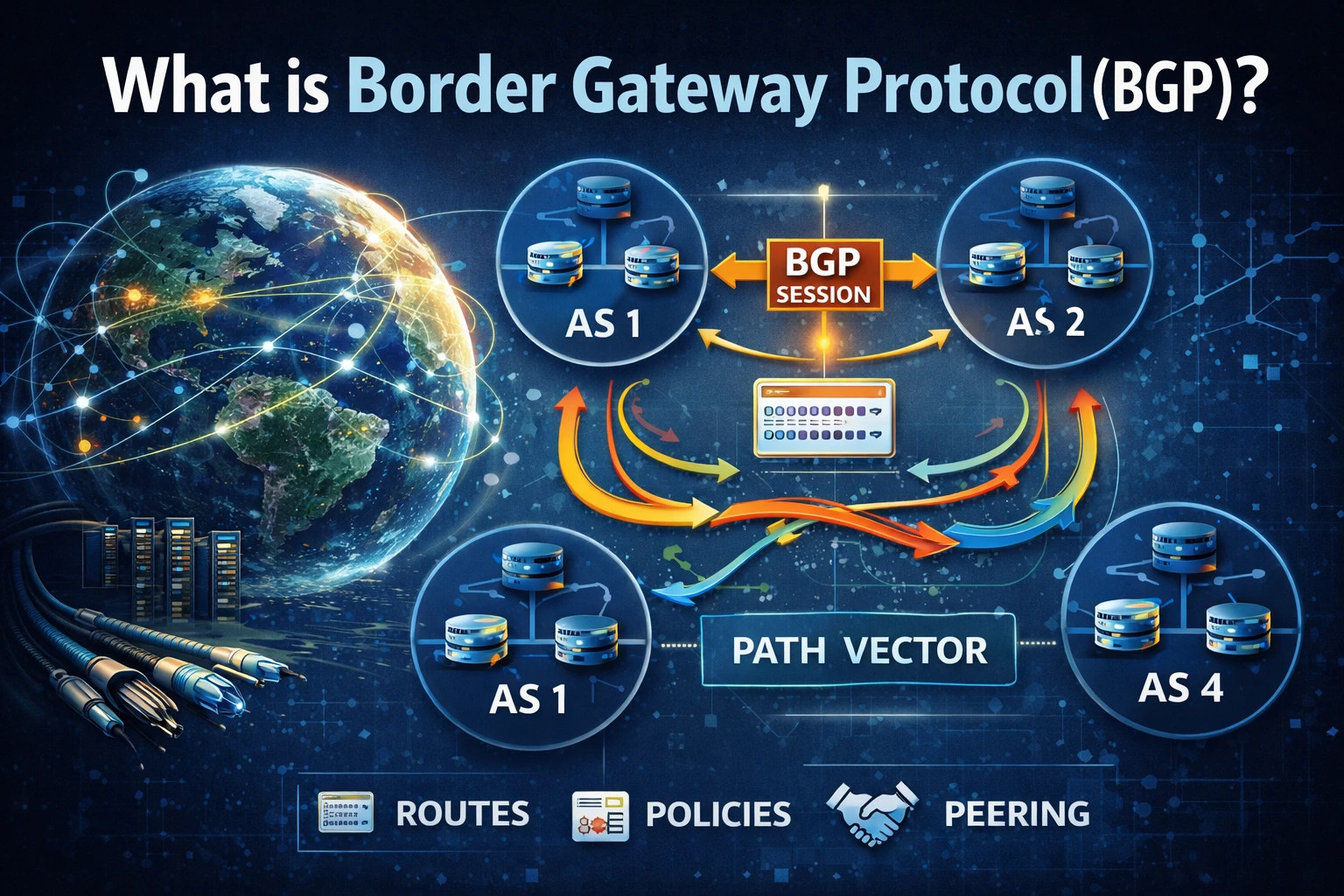
Border Gateway Protocol, usually called BGP, is the routing protocol that helps the Internet move traffic between large independent networks. In simple terms, BGP tells one network which IP address ranges another network can reach and which path traffic can take to get there. It is one of the core protocols that makes the global Internet work at scale.
Without BGP, the Internet would not have a practical way to coordinate routing between the tens of thousands of separate networks that make up global connectivity. Instead of every network operating in isolation, BGP allows them to exchange reachability information and build paths for Internet traffic.
What Does BGP Do?
BGP is used to announce which IP prefixes a network can deliver traffic to and to learn which neighboring networks can help reach other destinations. These announcements let routers build a map of possible paths across the Internet. When traffic needs to travel from one network to another, BGP helps determine the route it should follow.
This is why BGP is often described as the Internet’s routing protocol. It does not move the packets itself, but it provides the route information that routers use to forward them correctly.
What Is an Autonomous System?
To understand BGP, it helps to understand the idea of an Autonomous System, or AS. An Autonomous System is a network or group of networks under a common routing policy, usually operated by an ISP, cloud provider, enterprise, content network, or other large infrastructure operator. Each AS is identified by an Autonomous System Number, or ASN. BGP is the protocol these systems use to exchange route information with one another.
How BGP Works in Simple Terms
1. Networks announce prefixes
A network tells its neighbors which IP prefixes it can reach. These announcements are exchanged through BGP sessions between routers.
2. Routers compare available paths
A router may learn several possible paths to the same destination. BGP then applies selection logic and routing policy to choose the preferred path.
3. Traffic follows the chosen route
Once the route is selected, traffic can be forwarded through a sequence of networks until it reaches the destination prefix.
Why BGP Is Important
BGP is important because the Internet is not one single network. It is a federation of many separate networks that need a shared way to exchange routing information. BGP provides that coordination layer. It allows cloud providers, ISPs, carriers, enterprises, and content delivery networks to connect their infrastructures into one global routing system.
This is also why BGP is deeply connected to IP address management. Route announcements depend on which network is authorized to originate a prefix, so routing and IP resource control are closely linked. For broader background, it also helps to understand Regional Internet Registries and how Internet number resources are coordinated.
BGP and TCP
BGP peers exchange routing information over TCP rather than using a separate transport protocol. This helps provide reliable message delivery between BGP routers. NIST notes that BGP peers use TCP to exchange routing information in the form of address prefixes and path-related data.
eBGP vs iBGP
| Type | Meaning | Typical use |
|---|---|---|
| eBGP | External BGP between different Autonomous Systems | Used between separate networks such as ISPs, cloud providers, and customers |
| iBGP | Internal BGP within the same Autonomous System | Used to distribute BGP-learned routes inside one organization’s AS |
NIST explains that external routers use eBGP, while iBGP and eBGP are the same protocol with different routing rules and different operating context.
What Information Does BGP Advertise?
BGP mainly advertises IP prefixes and the path information associated with them. One of the most visible pieces of path data is the AS path, which shows the sequence of Autonomous Systems that a route has passed through. This helps routers evaluate path options and apply routing policy.
Why BGP Security Matters
BGP is essential, but historically it was not built with strong built-in route validation. NIST documents that BGP-related anomalies such as prefix hijacking, route leaks, and other forms of misrouting can cause denial of service, unwanted traffic detours, and performance degradation. That is why routing security mechanisms such as RPKI, Route Origin Authorization, route origin validation, and prefix filtering have become increasingly important. NIST’s newer guidance continues to recommend these controls to improve the security and resilience of Internet routing.
What Is BGP Hijacking?
BGP hijacking happens when a network incorrectly or maliciously announces IP prefixes it is not supposed to originate. This can pull traffic onto the wrong path, blackhole it, or expose it to interception. Cloudflare and NIST both describe route hijacking as a serious routing security risk.
Why Businesses Should Care About BGP
Businesses may not configure BGP directly, but they still depend on it whenever they use cloud services, transit providers, colocation, CDNs, or multi-homed network connections. BGP affects reachability, latency, failover, and the integrity of how customer traffic reaches services. If routing becomes unstable or insecure, the business impact can be immediate.
BGP and IPv4 / IPv6 Routing
BGP is used to distribute reachability for both IPv4 and IPv6 prefixes across inter-network boundaries. That is one reason BGP remains central to both today’s IPv4-based Internet and long-term IPv6 growth. For extra context, it also helps to understand what IP addresses are and why they matter.
Conclusion
Border Gateway Protocol, or BGP, is the routing protocol that enables separate networks to exchange reachability information and move Internet traffic across Autonomous Systems. It is one of the core systems that makes the Internet function as a global network rather than a collection of isolated islands. Because BGP controls how prefixes are announced and how traffic finds its path, it is essential not only for connectivity but also for routing security, resilience, and trust on the modern Internet.
Read More: The Role of the LOA in IPv4 Leasing
Read More: What Is IP Address Space?
Supporting References
- RFC 4271: A Border Gateway Protocol 4 (BGP-4)
- NIST SP 800-189: Resilient Interdomain Traffic Exchange
- NIST SP 1800-14: Protecting the Integrity of Internet Routing
- Cloudflare: What is BGP?
- Cloudflare: What is BGP hijacking?
Frequently Asked Questions (FAQ)
1. What is BGP in simple terms?
BGP is the protocol that helps separate Internet networks tell each other which IP prefixes they can reach and which path traffic should take.
2. What does BGP stand for?
BGP stands for Border Gateway Protocol.
3. Why is BGP important?
It is important because it enables routing between Autonomous Systems and makes the global Internet practical to operate at scale.
4. What is the difference between eBGP and iBGP?
eBGP is used between different Autonomous Systems, while iBGP is used inside the same Autonomous System.
5. What is a BGP hijack?
A BGP hijack happens when a network incorrectly or maliciously announces IP space it is not supposed to originate, causing traffic to be diverted or disrupted.