


Understanding IP Address Blocks
 Published:Last Updated:
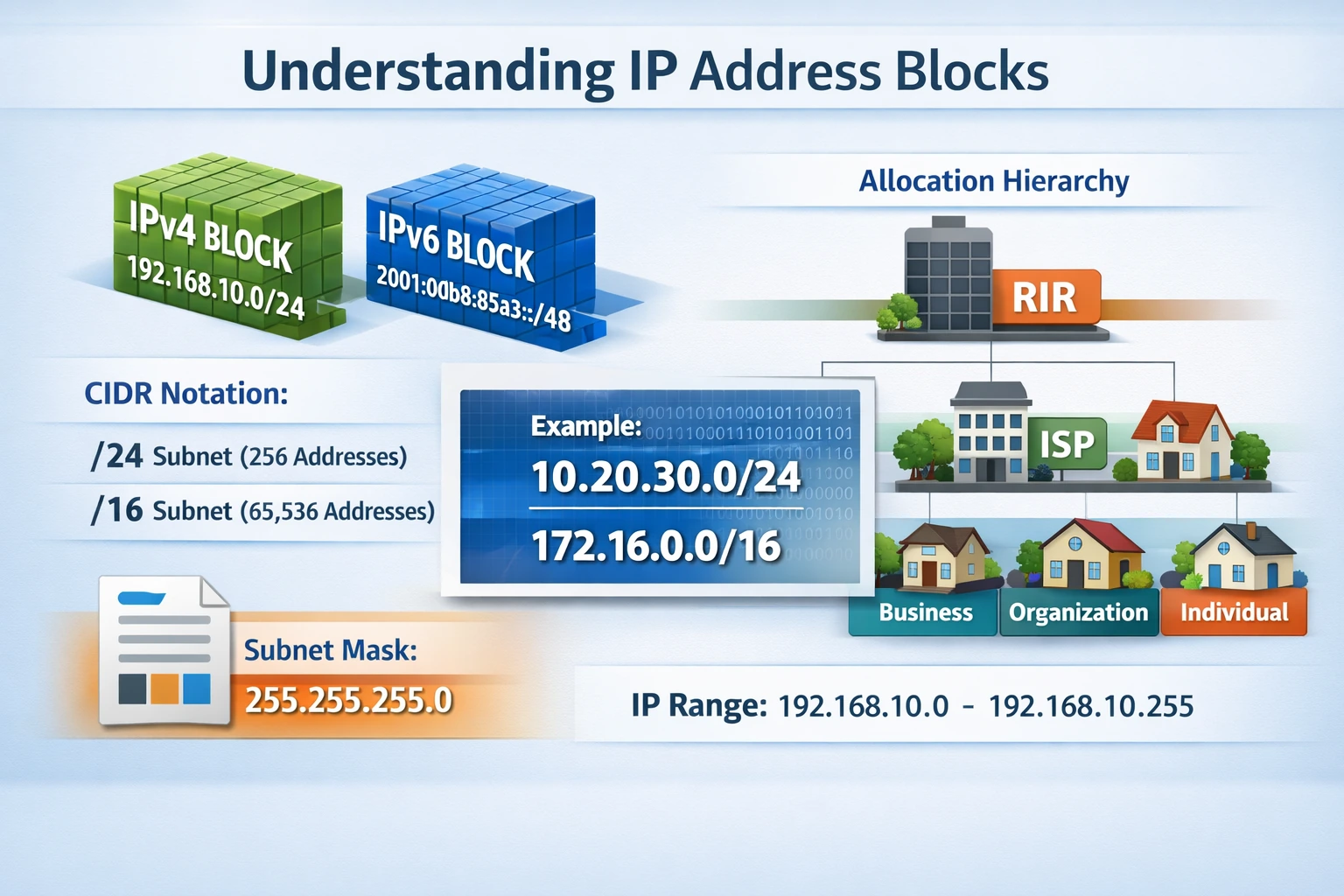
Table of Contents
- What Is an IP Address Block?
- Why IP Address Blocks Matter
- IPv4 vs IPv6 IP Address Blocks
- How CIDR Notation Works
- Common IPv4 Block Sizes
- Common IPv6 Block Sizes
- IPv4 Blocks in More Detail
- IPv6 Blocks in More Detail
- Who Manages IP Address Blocks?
- How IP Address Blocks Are Used in Practice
- Why Understanding IP Blocks Matters Today
- Conclusion
- Supporting References
- Frequently Asked Questions (FAQ)
Understanding IP address blocks is essential for anyone working with networks, cloud infrastructure, hosting environments, or Internet number resources. An IP address block is a grouped range of IP addresses managed as a single unit for allocation, routing, and operational use.
Instead of handling every IP address one by one, the Internet uses address blocks so that networks can be organized more efficiently. This makes it easier to assign resources, design subnets, manage routing, and scale Internet infrastructure.
What Is an IP Address Block?
An IP address block is a continuous range of IP addresses that share the same network prefix. It is usually written in CIDR notation, such as 192.168.1.0/24 for IPv4 or 2001:db8::/32 for IPv6. The number after the slash shows how much of the address identifies the network portion.
In simple terms, a shorter prefix usually means a larger block, while a longer prefix usually means a smaller and more specific block.
Why IP Address Blocks Matter
IP blocks matter because they are the practical unit of Internet addressing. Registries allocate them, ISPs assign them, enterprises subdivide them, and routers use them to decide where traffic should go. Without blocks, Internet routing and address management would be far more complex and far less scalable.
IPv4 vs IPv6 IP Address Blocks
| Feature | IPv4 | IPv6 |
|---|---|---|
| Address length | 32-bit | 128-bit |
| Example block | 192.168.1.0/24 | 2001:db8::/32 |
| Notation style | Dotted decimal + CIDR | Hexadecimal + CIDR |
| Address space size | Limited and scarce | Extremely large |
| Typical market importance | High commercial value due to scarcity | Used for long-term network growth and scale |
| Operational reality today | Still widely used across hosting, cloud, and public services | Increasingly deployed, often alongside IPv4 |
IPv4 blocks remain commercially important because public IPv4 space is limited. IPv6 blocks, by contrast, are designed for scale and long-term growth. This is one reason the Internet continues to operate in a mixed environment where both protocols matter.
How CIDR Notation Works
CIDR stands for Classless Inter-Domain Routing. It is the standard way modern IP address blocks are written. The prefix tells you how much of the address is fixed as the network portion, while the remaining bits can be used inside that block.
For example, 10.0.0.0/16 is a larger IPv4 block than 10.0.0.0/24, because /16 fixes fewer bits and leaves more room for addresses inside the block.
Common IPv4 Block Sizes
| CIDR Block | Total IPv4 Addresses | Simple Meaning | Typical Use |
|---|---|---|---|
| /24 | 256 | A small standard block | Small network segments, transfers, leasing units |
| /23 | 512 | Two /24 blocks combined | Larger small networks, modest public usage |
| /22 | 1,024 | Four /24 blocks combined | Enterprise segments, hosting environments |
| /20 | 4,096 | Medium-size block | Cloud pools, larger internal planning |
| /16 | 65,536 | Large IPv4 block | Large enterprises, major network operators |
Common IPv6 Block Sizes
| CIDR Block | Simple Meaning | Typical Use |
|---|---|---|
| /64 | Standard subnet size in many IPv6 designs | Single IPv6 subnet |
| /56 | Contains 256 separate /64 subnets | Small site allocation, branch or customer usage |
| /48 | Contains 65,536 separate /64 subnets | Common site allocation for organizations |
| /32 | Very large allocation | Typical large-provider or registry-distributed block size |
IPv4 Blocks in More Detail
IPv4 address blocks are built from a 32-bit address space. Because that space is limited, public IPv4 blocks have become scarce and commercially significant. This is why IPv4 blocks are frequently discussed in the context of transfers, leasing, monetisation, and infrastructure planning.
Some IPv4 ranges are public and routable. Others are reserved for private or special-purpose use. For example, private IPv4 ranges such as 10.0.0.0/8, 172.16.0.0/12, and 192.168.0.0/16 are not publicly routable on the global Internet.
IPv6 Blocks in More Detail
IPv6 address blocks are built from a 128-bit address space. That makes the available address range vastly larger than IPv4. IPv6 was designed to support long-term Internet growth, more flexible allocation, and cleaner hierarchical addressing models.
Unlike IPv4, IPv6 planning is usually less about scarcity and more about proper structure. A well-designed IPv6 plan often starts by thinking in blocks and subnet boundaries rather than worrying about “running out” soon.
Who Manages IP Address Blocks?
At the global level, IP address blocks are coordinated by IANA. Those resources are then distributed through the Regional Internet Registries, which manage allocation and registration in their own service regions.
If you want the wider governance context, it also helps to understand how Regional Internet Registries fit into the Internet number resource system.
How IP Address Blocks Are Used in Practice
Subnetting
Large blocks are often divided into smaller subnets for departments, applications, security zones, cloud segments, or customer assignment.
Routing
Routers use prefixes and address blocks to determine how traffic should move across networks. Working with blocks instead of individual addresses makes global routing manageable.
Cloud Design
In cloud environments, CIDR blocks are used to define VPCs, subnets, internal ranges, and IPv6 allocations. Good cloud network planning depends heavily on understanding block sizes and boundaries.
Why Understanding IP Blocks Matters Today
Understanding IP address blocks matters because block-based thinking is everywhere in modern networking. It affects subnet design, routing, registry allocation, cloud deployment, IPv4 pricing, and IPv6 planning. In IPv4 especially, block size and quality can even influence commercial value.
That is also why the broader discussion about IPv6, scarcity, and real-world demand remains relevant when people compare IPv4 and IPv6 blocks today.
Conclusion
An IP address block is a grouped range of IP addresses managed as a single unit for allocation, routing, and operational use. IPv4 and IPv6 both rely on block-based design, but they differ greatly in size, scarcity, and planning logic. IPv4 blocks remain commercially important because public IPv4 space is limited, while IPv6 blocks provide the structure needed for long-term Internet growth. Understanding IP address blocks makes networking concepts much easier to understand and apply in real infrastructure work.
Read More: What Is IP Address Space?
Read More: The Introduction of IPv6
Supporting References
- IANA IPv4 Address Space Registry
- RFC 4291: IP Version 6 Addressing Architecture
- RFC 4632: CIDR Strategy and Aggregation
- ARIN CIDR Chart: IPv4 and IPv6 Block Size Equivalents
- ARIN: IPv4 Private Address Space and Filtering
Frequently Asked Questions (FAQ)
1. What is an IP address block?
An IP address block is a contiguous range of IP addresses grouped together under a shared prefix and managed as one unit.
2. What does /24 or /48 mean?
These are CIDR prefix lengths. They show how much of the address is fixed as the network portion. In general, a shorter prefix means a larger block.
3. Are IPv4 and IPv6 blocks managed the same way?
Both use CIDR blocks and registry allocation, but IPv4 is scarce while IPv6 has a vastly larger address space and is planned differently.
4. Why is a /24 important in IPv4?
A /24 is a common small IPv4 block containing 256 total addresses, and it is often treated as a standard operational or market unit.
5. Why is a /64 important in IPv6?
A /64 is widely treated as the standard IPv6 subnet size in many real deployments and design models.