


The Introduction of IPv6
 Published:Last Updated:
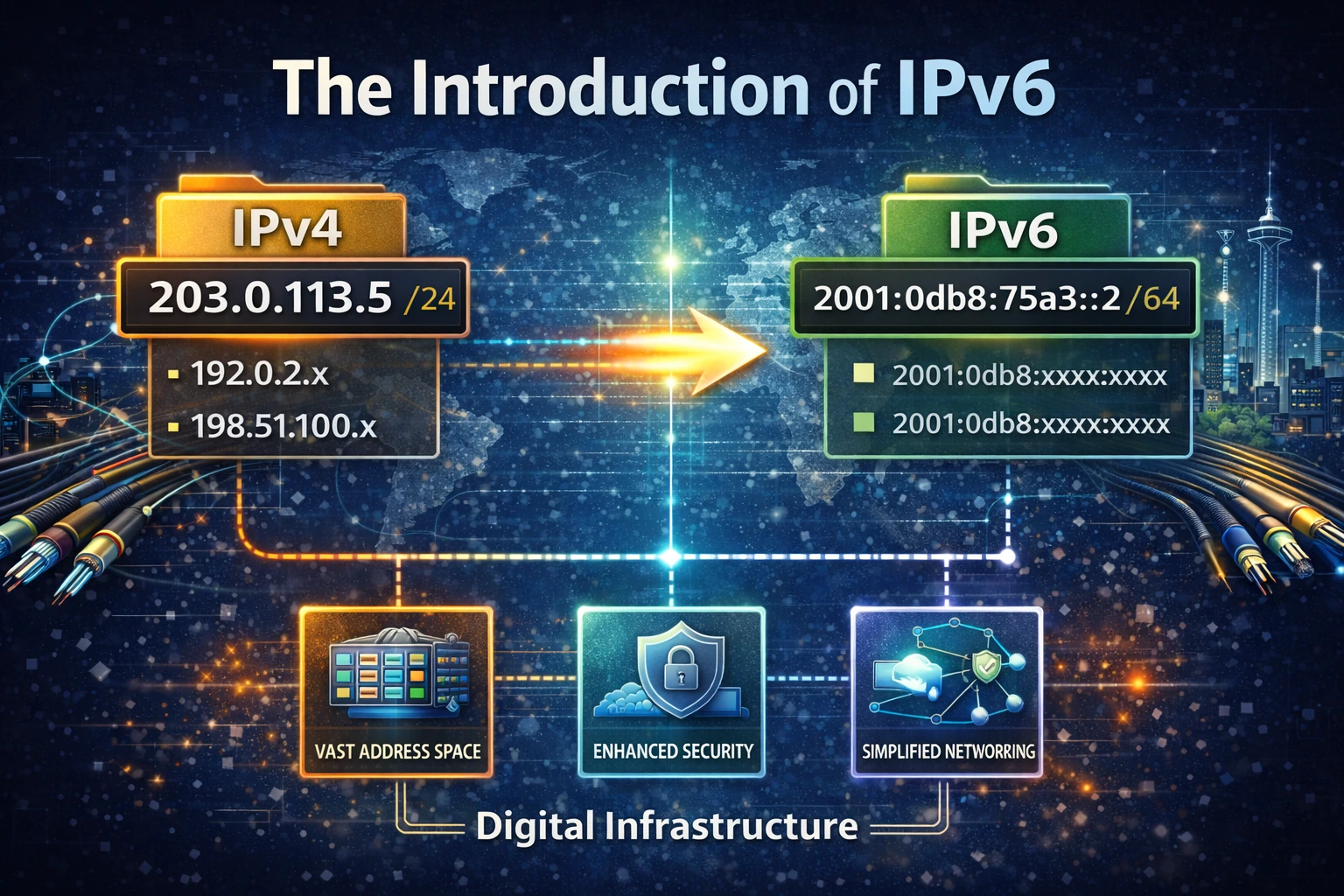
IPv6, or Internet Protocol version 6, is the successor to IPv4 and was developed to support the continued growth of the Internet. As the number of connected devices, users, and online services expanded worldwide, the limitations of IPv4 became increasingly clear. IPv6 was introduced to provide a far larger address space and to support the long-term scalability of modern Internet infrastructure.
Today, IPv6 is recognized as a key part of the Internet’s future because it enables more efficient addressing, supports continued network growth, and helps reduce dependence on the increasingly limited IPv4 address space.
Table of Contents
- What Is IPv6?
- Why IPv6 Was Introduced
- How IPv6 Addresses Look
- Key Benefits of IPv6
- IPv4 vs IPv6
- Why IPv6 Adoption Has Been Gradual
- Why IPv6 Matters for Businesses
- Conclusion
- Frequently Asked Questions (FAQ)
What Is IPv6?
IPv6 is the latest version of the Internet Protocol used to identify and route traffic between devices on a network. Like IPv4, it allows devices to communicate across the Internet, but it was designed with a much larger address capacity and a more modern structure to support the growth of global connectivity.
To understand why IPv6 matters, it also helps to understand what IP addresses are and why they remain fundamental to Internet communication.
Why IPv6 Was Introduced
IPv6 was introduced because IPv4 could not provide enough addresses for the long-term growth of the Internet. IPv4 uses a 32-bit address system, which severely limits the number of unique public IP addresses available. As Internet adoption spread across households, businesses, mobile devices, cloud platforms, and digital services, this address space became increasingly constrained.
As IPv4 exhaustion became a structural challenge, the way IP address allocation works became even more important for network operators and long-term infrastructure planning.
How IPv6 Addresses Look
Unlike IPv4 addresses, which are written as four decimal numbers separated by periods, IPv6 addresses use hexadecimal values separated by colons. A typical IPv6 address may look like this:
2001:0db8:85a3:0000:0000:8a2e:0370:7334
This format allows IPv6 to support a far greater number of unique addresses and gives network architects more flexibility in how addresses are structured and assigned.
Key Benefits of IPv6
1. Vastly Larger Address Space
The most important benefit of IPv6 is its enormous address capacity. This allows the Internet to continue growing without relying on the limited IPv4 space that has already been heavily depleted.
2. Better Support for Long-Term Internet Growth
IPv6 was created to support the future of global connectivity. As more devices, services, and applications require direct Internet access, IPv6 provides the scalability needed for long-term network expansion.
3. Improved Addressing Efficiency
IPv6 offers a more modern approach to address assignment and routing. This can make network design more flexible and can simplify certain aspects of infrastructure planning in large-scale environments.
4. Stronger Foundation for Modern Networks
As businesses, governments, service providers, and content platforms continue to expand, IPv6 provides a stronger protocol foundation for future services, large-scale connectivity, and ongoing digital transformation.
IPv4 vs IPv6
IPv4 and IPv6 serve the same general purpose: they identify devices and route data across networks. The main difference is scale. IPv4 uses 32-bit addresses, while IPv6 uses 128-bit addresses. This makes IPv6 much more suitable for the long-term expansion of the Internet.
Although IPv6 is the newer standard, IPv4 is still widely used. For this reason, many organizations continue to operate in mixed or dual-stack environments where both protocols are supported.
Why IPv6 Adoption Has Been Gradual
Even though IPv6 solves the address limitations of IPv4, adoption has been gradual because IPv4 remains deeply embedded in existing systems, applications, enterprise networks, and customer environments. Many organizations continue to rely on IPv4 compatibility, which means transition planning can take time.
This is also why the wider IPv6 scarcity narrative continues to be debated in Internet governance and infrastructure discussions.
Why IPv6 Matters for Businesses
For businesses, IPv6 matters because it supports future growth, improves long-term scalability, and reduces dependence on scarce IPv4 space. Organizations that build modern network infrastructure, expand digital services, or serve large numbers of users will increasingly benefit from IPv6 readiness.
IPv6 is especially relevant for service providers, cloud platforms, content delivery environments, and enterprises planning for sustainable long-term connectivity.
Conclusion
IPv6 is the next generation of the Internet Protocol and was introduced to solve the limitations of IPv4. With its 128-bit address space and more scalable design, IPv6 provides the foundation needed for the continued growth of the Internet. While adoption remains gradual in many environments, IPv6 is an essential part of the Internet’s long-term future and a critical consideration for any organization planning modern network infrastructure.
Read More: How to Transition from IPv4 to IPv6
Read More: What Is IPv4 Exhaustion?
Frequently Asked Questions (FAQ)
1. What is IPv6?
IPv6 is the latest version of the Internet Protocol, designed to replace or work alongside IPv4 and provide a much larger address space for global Internet growth.
2. Why was IPv6 introduced?
IPv6 was introduced because IPv4 does not provide enough addresses for the long-term growth of the Internet and the increasing number of connected devices and services.
3. What is the difference between IPv4 and IPv6?
The main difference is address size. IPv4 uses 32-bit addresses, while IPv6 uses 128-bit addresses, giving IPv6 a vastly larger number of unique addresses.
4. Is IPv6 replacing IPv4 completely?
Not immediately. Many networks still use IPv4, so IPv6 is often deployed alongside IPv4 in dual-stack or transition environments.
5. Why is IPv6 important for the future?
IPv6 is important because it provides the scalability and addressing capacity needed to support the future growth of the Internet, connected devices, and digital services.