


The Impact of IPv4 Address Depletion on Global Internet Infrastructure
 Published:Last Updated:
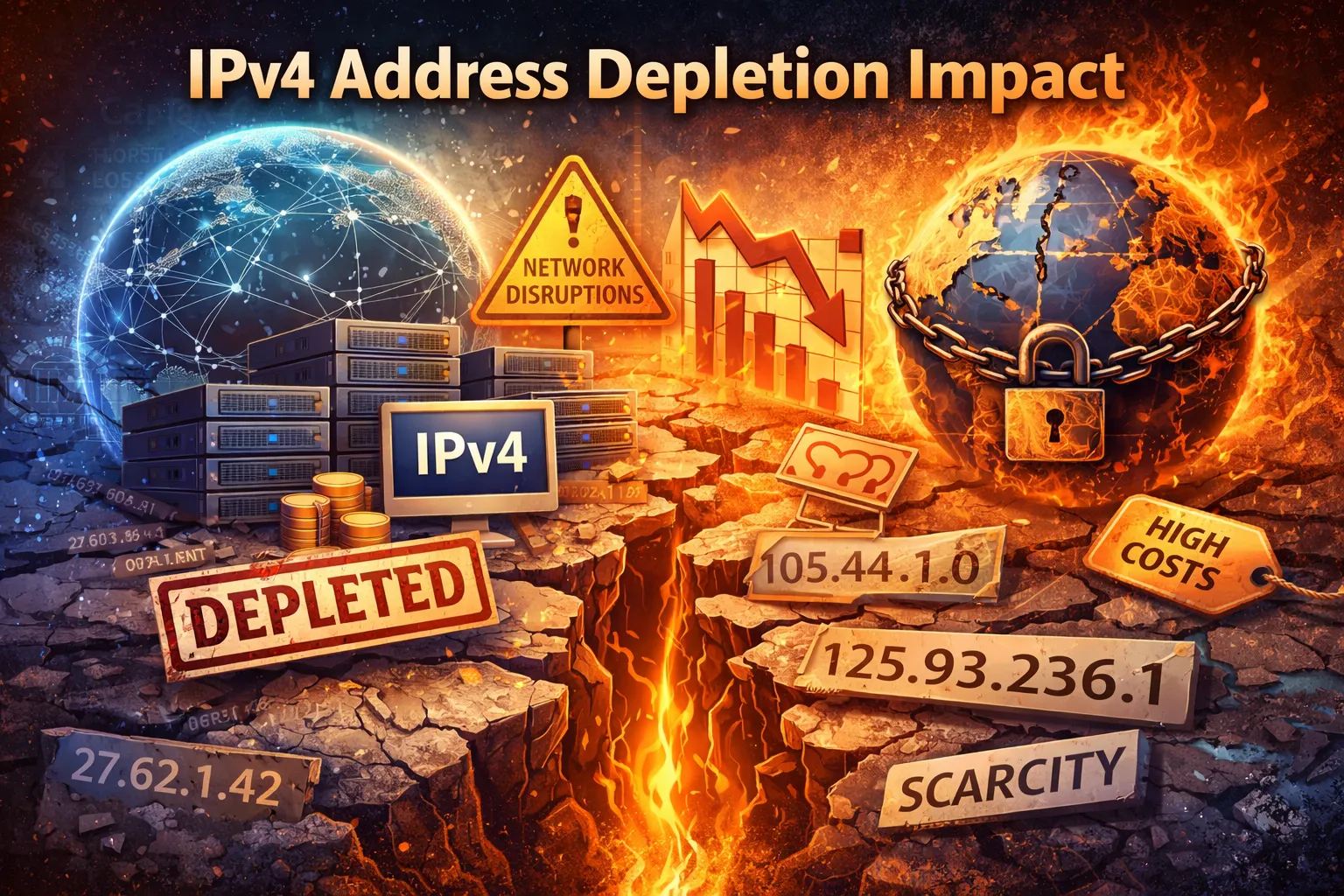
IPv4 address depletion has had a major impact on global Internet infrastructure. As the pool of freely available IPv4 addresses became exhausted, organizations around the world were forced to rethink how they acquire, manage, and use public IP resources. What was once a routine technical resource has become a limited and strategically important part of network planning.
This shift has affected Internet service providers, hosting companies, cloud platforms, enterprises, and network operators that still rely on IPv4 compatibility for large parts of their infrastructure and customer-facing services.
What Is IPv4 Address Depletion?
IPv4 address depletion refers to the exhaustion of the available pool of unallocated IPv4 addresses. Because IPv4 uses a 32-bit address space, the number of possible public addresses is limited. As Internet adoption expanded across businesses, households, mobile devices, cloud services, and digital platforms, the available supply of IPv4 addresses steadily declined.
Once depletion occurred, obtaining new IPv4 resources became much more difficult, especially through traditional registry allocation channels.
Why IPv4 Depletion Happened
The main reason for IPv4 depletion is simple: the Internet grew far beyond what the original IPv4 address space was designed to support. As more people, devices, applications, and connected services came online, demand for publicly routable IPv4 addresses increased rapidly.
This demand was further intensified by the rise of broadband access, smartphones, cloud computing, content delivery, hosting services, and large-scale enterprise networking.
The Global Impact on Internet Infrastructure
1. Greater Pressure on IPv4 Resource Management
As IPv4 space became limited, organizations had to use their existing resources more efficiently. This led to stronger focus on address planning, inventory control, reclaiming unused space, and careful allocation of public IPs to systems that truly needed them.
2. Growth of the IPv4 Transfer and Leasing Market
Depletion changed IPv4 from a widely available technical resource into a market-driven operational asset. As a result, transfers, sales, and leasing became increasingly important ways for organizations to access IPv4 address space. Companies that still needed public IPv4 resources could no longer rely on broad free-pool allocations and often had to obtain space from existing holders.
3. Slower and More Complex Network Expansion
For many organizations, IPv4 depletion made infrastructure expansion more complex. Deploying new services, entering new markets, scaling public platforms, or supporting more customers often required additional IPv4 space that was no longer easy to obtain. This increased planning pressure and often added commercial and operational cost to growth.
4. Stronger Incentive for IPv6 Adoption
IPv4 depletion has also accelerated the push toward IPv6, which offers a vastly larger address space. Although IPv6 is widely recognized as the long-term solution, the transition has been gradual, and many organizations still operate in environments where IPv4 remains essential for compatibility and reachability.
How Regional Internet Registries Were Affected
IPv4 depletion did not affect all regions in exactly the same way, but every Regional Internet Registry eventually moved into post-exhaustion conditions. Different registries adopted their own policies for limited allocations, recovery mechanisms, waiting lists, and transfer frameworks.
This means organizations today must pay close attention to regional rules when planning how to obtain or transfer IPv4 resources.
Why IPv4 Depletion Still Matters Today
Even though IPv4 depletion is not a new event, its effects continue to shape modern Internet infrastructure. Many hosting platforms, enterprise systems, SaaS environments, security appliances, and public-facing services still require IPv4 support. As a result, depleted supply continues to influence pricing, address strategy, deployment decisions, and long-term network design.
For businesses, this means IPv4 depletion is not just a historical milestone. It remains an active operational challenge.
Challenges Caused by IPv4 Depletion
Higher Acquisition Costs
Because IPv4 addresses are limited, obtaining them through market channels often requires significant cost. This can affect budgeting for infrastructure growth and service deployment.
Operational Complexity
Organizations must now manage IPv4 more carefully than before. Address planning, routing, reputation management, transfer procedures, and policy compliance have all become more important.
Dependency on Secondary Market Options
With free-pool options heavily limited, many organizations now depend on leasing, transfers, and other secondary market approaches to meet IPv4 needs. This adds commercial and legal considerations that did not matter as much in the early Internet era.
How Organizations Respond to IPv4 Depletion
Most organizations respond to IPv4 depletion in one or more of the following ways:
• reclaiming and reusing unused IPv4 space
• improving address efficiency across infrastructure
• buying or transferring IPv4 where policy allows
• leasing IPv4 for flexibility or lower upfront commitment
• preparing for long-term IPv6 adoption
Conclusion
IPv4 address depletion has had a lasting impact on global Internet infrastructure. It transformed IPv4 from a broadly available technical resource into a limited and strategically significant part of digital operations. As a result, organizations now face greater pressure to manage address space carefully, rely more on transfers and leasing, and plan more seriously for long-term protocol strategy. Even in an IPv6-capable world, the effects of IPv4 depletion continue to influence how the Internet grows and how infrastructure is built.
Read More: What Is IPv4 Exhaustion?
Read More: How to Transition from IPv4 to IPv6
Frequently Asked Questions (FAQ)
1. What is IPv4 address depletion?
IPv4 address depletion means the pool of unallocated IPv4 addresses has been exhausted, making it much harder to obtain new public IPv4 space through traditional allocation channels.
2. Why does IPv4 depletion matter for businesses?
It matters because many businesses still depend on IPv4 for hosting, customer connectivity, cloud deployment, and infrastructure growth. Limited supply makes planning and acquisition more important.
3. Did IPv4 depletion stop IPv4 from working?
No. IPv4 still works and remains widely used. Depletion means the freely available supply of new addresses became limited, not that the protocol stopped functioning.
4. Is IPv6 the solution to IPv4 depletion?
Yes, IPv6 is the long-term solution because it provides a much larger address space. However, many organizations still rely on IPv4 today for compatibility and operational reasons.
5. How do companies deal with IPv4 depletion?
Companies typically respond by improving address efficiency, reclaiming unused space, transferring or leasing IPv4, and gradually preparing for wider IPv6 adoption.