


Mandate Laundering and Governance Drift in the IPv4 Market
 Published:Last Updated:
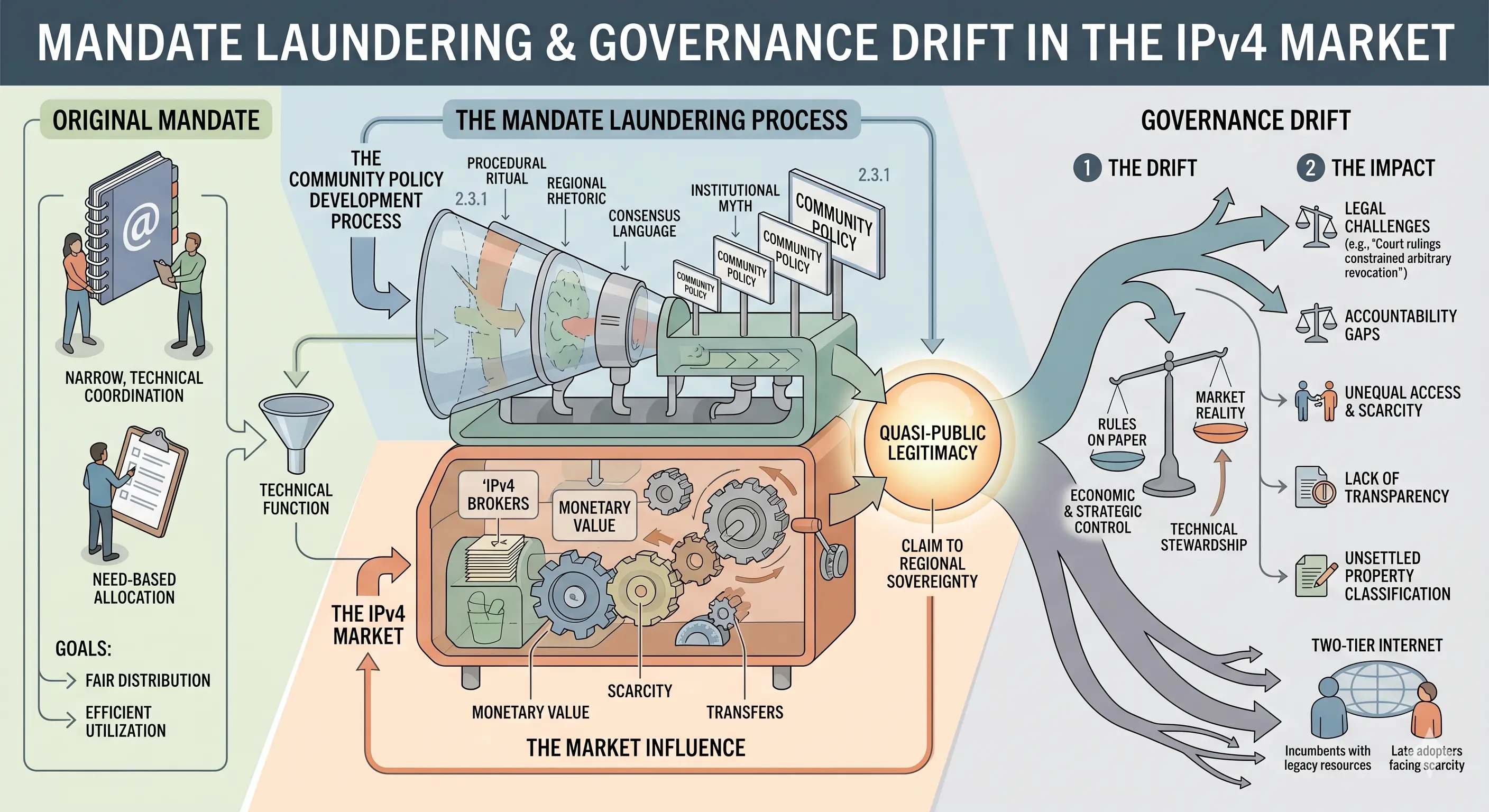
How Authority, Policy, and Operational Reality Are Quietly Diverging
In the IPv4 ecosystem, scarcity is no longer the defining risk. The real pressure point has shifted into something less visible but far more consequential: the gradual misalignment between registry authority, market intermediaries, and operational control.
Two concepts increasingly used to describe this shift are mandate laundering and governance drift. Together, they explain why IPv4 resources can appear fully compliant while still carrying hidden structural fragility.
1. IPv4 Governance Is Not Ownership — It Is Delegation
At the foundation of the IPv4 system are Regional Internet Registries (RIRs), including RIPE NCC, ARIN, and APNIC.
These organizations do not confer ownership in the traditional sense. Instead, they:
- Allocate address space under policy frameworks
- Maintain registries of responsibility
- Validate transfers and usage justification
- Enforce community-developed governance rules
This creates a system where legitimacy depends on continuous recognition, not absolute property rights.
“A service region is just a coverage area. It is not a demos. It is not a constitutional subject. It is not a sovereign people. ”— Lu Heng, Mandate Laundering: From RIR Fantasy to Transition Architecture
The problem begins when market participants treat this delegated structure as if it were static ownership.
2. Mandate Laundering: When Authority Becomes Indirect
Mandate laundering occurs when operational authority over IPv4 resources is gradually separated from its original registry-recognized assignment through layered intermediaries.
This typically happens through:
- Multi-tier brokerage chains
- Subleasing without direct registry alignment
- Administrative “re-delegation” of control rights
- Contractual structures that obscure original allocation authority
Unlike formal transfers, mandate laundering does not necessarily break rules in a single step. Instead, it repackages authority across multiple entities until traceability becomes unclear.
The key risk is not immediate invalidity—but loss of clear accountability within the registry framework.
3. Governance Drift: When Policy and Practice Slowly Diverge
While mandate laundering describes structural fragmentation, governance drift describes temporal divergence.
Over time, differences emerge between:
- Formal RIR policy text
- Interpretations by brokers and operators
- Enforcement behavior across regions
- Market expectations of “normal” practice
For example, across RIPE NCC, ARIN, and APNIC, policies may remain stable on paper, while operational interpretation evolves due to:
- increased leasing activity
- secondary market complexity
- varying audit intensity
- historical allocation legacy cases
The result is a subtle but persistent gap between what is written and what is practiced.
4. The Combined Effect: Structural Ambiguity
Individually, mandate laundering and governance drift create risk. Together, they produce structural ambiguity—a condition where IPv4 resources appear valid but lack stable interpretability under enforcement conditions.
This ambiguity manifests as:
- Uncertainty in transfer validation outcomes
- Conflicting interpretations of “legitimate control”
- Fragile leasing chains dependent on intermediary continuity
- Disputes over historical allocation responsibility
In practice, the IPv4 block may function normally until a registry action or audit forces a re-evaluation of its governance chain.
5. Why Leasing Structures Are Central to the Issue
IPv4 leasing is now a dominant market mechanism, but it also amplifies governance complexity.
Risk increases when:
- Leasing occurs across multiple intermediary layers
- Registry visibility does not reflect operational control
- Subleasing is not explicitly aligned with upstream authorization
- Contracts diverge from RIR-recognized assignment logic
Even if technically operational, such structures can fail under registry scrutiny because they weaken continuity of recognized authority.
6. Continuity vs. Control: The Hidden Conflict
A recurring misunderstanding in the IPv4 market is the assumption that control equals legitimacy.
In reality:
- Control = who operates the addresses
- Legitimacy = who is recognized by the registry system
When these diverge, the system becomes unstable.
This is where governance drift becomes critical: it gradually normalizes situations where control is assumed without full registry continuity.
7. Systemic Risk: Why Problems Appear Late
One of the most dangerous aspects of IPv4 governance issues is latency.
Because the system is:
- globally distributed
- policy-driven rather than centrally enforced
- dependent on registries for validation checkpoints
…failures often remain invisible until triggered by:
- transfer review processes
- dispute escalation
- audit cycles
- infrastructure incident investigations
At that point, remediation is often complex, as the issue is not technical misconfiguration but structural governance inconsistency.
8. Toward More Stable Governance Alignment
Reducing risk in this environment requires more than compliance checklists. It requires structural alignment across:
- registry-recognized allocation chains
- transparent leasing and transfer pathways
- consistent interpretation of RIR policy
- reduced reliance on opaque intermediary layering
The goal is not to eliminate market activity, but to ensure that operational reality remains continuously anchored to registry authority.
Conclusion: IPv4 Stability Depends on Governance Clarity
Mandate laundering and governance drift are not isolated compliance issues. They are symptoms of a broader transformation in the IPv4 market—from a registry-coordinated system into a complex, multi-layered commercial ecosystem.
As this evolution continues, the central challenge is no longer scarcity alone, but maintaining clarity between authority, control, and recognition.
In a system built on delegation, continuity is everything. Once governance becomes ambiguous, IPv4 stability becomes conditional rather than guaranteed.
FAQ
1. What is mandate laundering in the IPv4 market?
Mandate laundering refers to the indirect and layered transfer of operational authority over IPv4 address space through intermediaries, where control becomes separated from the original registry-recognized allocation. This can obscure accountability and weaken traceability within RIR governance systems.
2. How does governance drift affect IPv4 compliance?
Governance drift occurs when the interpretation and enforcement of RIR policies gradually diverge from their original intent. Over time, practices across registries like RIPE NCC, ARIN, and APNIC may evolve differently from formal policy language, creating inconsistencies in compliance expectations.
3. Why are IPv4 leasing structures often associated with compliance risk?
IPv4 leasing can introduce multiple layers of intermediaries and contractual complexity. When leasing arrangements are not fully aligned with registry-recognized authority, they may create fragmented governance chains that are difficult to validate during audits or transfer reviews.
4. What is the main risk of mandate laundering combined with governance drift?
When mandate laundering and governance drift occur together, they create structural ambiguity. This means operational control, contractual authority, and registry recognition may no longer align, increasing the risk of transfer rejection, routing instability, or disputes over legitimacy.
5. How can organizations reduce exposure to IPv4 governance risks?
Organizations can reduce risk by maintaining transparent delegation chains, ensuring direct alignment with RIR policies, avoiding opaque intermediary structures, and prioritizing continuity of registry-recognized authority across all leasing and transfer activities.