


Leasing VS Buying IPv4 address
 Published:Last Updated:
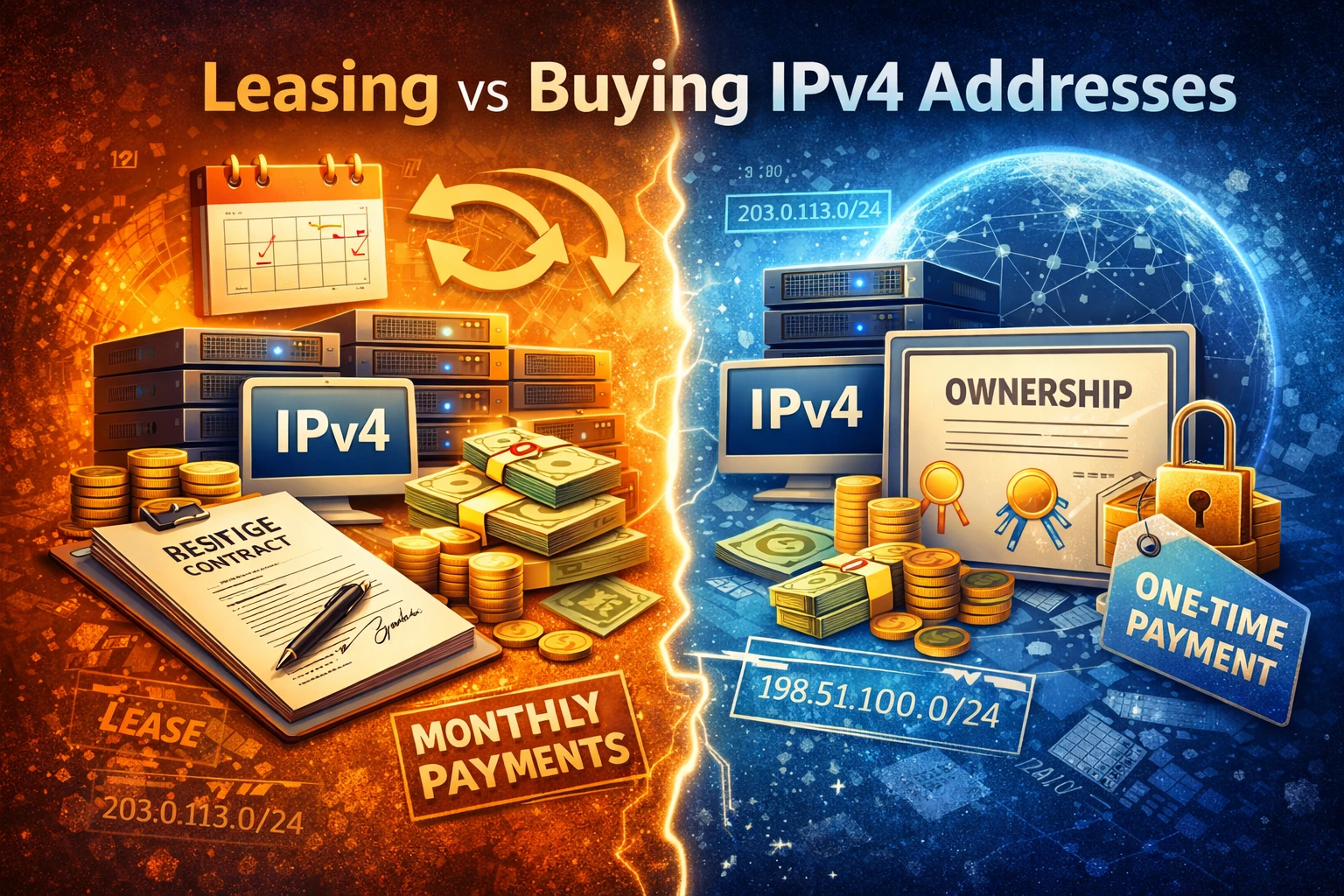
Leasing and buying IPv4 addresses are two different ways for organizations to secure the public IP resources they need. Buying usually gives the organization long-term control of the address block through a transfer process, while leasing provides temporary access for a defined period without requiring a full acquisition.
In today’s post-exhaustion market, the choice between leasing and buying depends on budget, time horizon, infrastructure plans, and how strategically important IPv4 resources are to the business. For some companies, buying offers stability and control. For others, leasing offers flexibility and lower upfront cost.
Table of Contents
- What Does It Mean to Buy IPv4 Addresses?
- What Does It Mean to Lease IPv4 Addresses?
- Why the Leasing vs Buying Decision Matters
- Main Advantages of Buying IPv4
- Main Advantages of Leasing IPv4
- Leasing vs Buying: Key Differences
- When Buying May Be the Better Choice
- When Leasing May Be the Better Choice
- What Businesses Should Evaluate Before Deciding
- Why the Market Still Supports Both Models
- Conclusion
- Frequently Asked Questions (FAQ)
What Does It Mean to Buy IPv4 Addresses?
Buying IPv4 addresses generally means acquiring registered IPv4 resources through a policy-compliant transfer process. Once the transfer is completed, the buyer gains long-term control of the block and can use it as part of its own network or infrastructure strategy.
This option is often preferred by organizations that want long-term certainty, stable holdership, and more direct control over their public address resources.
What Does It Mean to Lease IPv4 Addresses?
Leasing IPv4 addresses means paying for the right to use address space for a specified period without acquiring it permanently. This model allows organizations to access the IPv4 they need while avoiding the larger upfront cost of a full purchase.
For businesses with short- to medium-term needs, leasing can be a practical option that supports growth while preserving capital and operational flexibility.
Why the Leasing vs Buying Decision Matters
Because public IPv4 remains limited, organizations often cannot treat address acquisition as a routine technical task. The decision to lease or buy affects capital allocation, long-term planning, and even how IPv4 is treated on the balance sheet or within broader infrastructure strategy.
In some cases, the decision is also tied to whether the organization sees IPv4 as a short-term operational requirement or as a strategic asset with enduring value.
Main Advantages of Buying IPv4
1. Long-Term Control
Buying gives the organization long-term control over the address block. This can be important for infrastructure that must remain stable over many years, such as large hosting platforms, enterprise networks, cloud environments, and customer-facing services.
2. Greater Strategic Certainty
An organization that buys IPv4 does not have to rely on future lease renewals or risk needing to return the addresses at the end of a contract. This can make long-term planning simpler and reduce uncertainty for critical systems.
3. Potential Asset Value
For some organizations, buying aligns with the view that IPv4 space remains a strategic infrastructure asset. This is why many enterprises now evaluate long-term enterprise value in IPv4 assets instead of treating public IP space as a purely technical purchase.
Main Advantages of Leasing IPv4
1. Lower Upfront Cost
Leasing usually requires less upfront capital than buying. This can make it more accessible for organizations that need IPv4 resources quickly but want to preserve cash for other areas of growth or operations.
2. More Flexibility
If IPv4 needs may change over time, leasing offers more flexibility. A business can use the address space for a defined period and adjust later based on actual operational requirements, migration plans, or budget priorities.
3. Useful for Transitional Needs
Leasing can be especially useful for organizations handling temporary demand, project-based growth, short-term hosting expansion, or staged infrastructure change. It can also be a practical option while evaluating longer-term IPv4 and IPv6 strategy.
Leasing vs Buying: Key Differences
1. Capital vs Operating Cost
Buying usually requires a larger upfront capital commitment. Leasing spreads the cost over time, which may better suit organizations that want an operating-cost model instead of a major one-time purchase.
2. Ownership vs Temporary Use
Buying is generally associated with long-term control of the address block. Leasing provides temporary rights to use the addresses without permanently acquiring them.
3. Stability vs Flexibility
Buying offers more long-term stability, while leasing offers more short-term flexibility. The better option depends on whether the organization’s priority is predictable long-term control or adaptable near-term access.
4. Strategic Asset vs Operational Utility
Some organizations buy because they see IPv4 as a durable strategic asset. Others lease because they view IPv4 as an operational requirement that should be accessed efficiently rather than owned permanently. This difference is part of the wider debate around how Internet number resources should be valued and governed.
When Buying May Be the Better Choice
Buying may be the better choice if your organization wants long-term certainty, expects to rely on the address space for many years, or wants to treat IPv4 as a lasting part of infrastructure planning. It may also be more suitable for companies that want to avoid future renewal dependency and prefer greater control over the asset.
When Leasing May Be the Better Choice
Leasing may be the better choice if your organization wants to reduce upfront spending, expects demand to change, or needs IPv4 space for a shorter timeframe. It can also be more appropriate when the organization wants to stay flexible while evaluating growth, cloud migration, or broader network transition plans.
What Businesses Should Evaluate Before Deciding
Time Horizon
A key question is how long the organization expects to need the IPv4 space. A longer time horizon may support the case for buying, while a shorter or uncertain horizon may support leasing.
Budget Structure
Companies should decide whether they prefer an upfront capital commitment or a recurring operating cost. This decision can affect not just finance, but also how infrastructure growth is paced.
Operational Strategy
The right option also depends on operational reality. A fast-growing platform with permanent IPv4 dependency may approach the decision differently from a business with transitional needs or a shorter deployment window.
Governance and Scarcity Context
The decision does not happen in a vacuum. It exists inside a system shaped by scarcity, secondary markets, and policy frameworks. That is why some observers still question the IPv6 escape from scarcity narrative when IPv4 remains commercially and operationally relevant.
It is also why many enterprises now treat address resources more like capital infrastructure, especially when evaluating whether investing in scarce digital resources makes more sense than relying only on temporary access.
Why the Market Still Supports Both Models
Both leasing and buying remain important because organizations have different financial and operational needs. Some want permanent control. Others want short-term access. The post-exhaustion IPv4 market continues to support both models because demand remains real and because public IPv4 is still widely required across live production environments.
This is also why case studies on how enterprises generate recurring income from IPv4 remain relevant: they show that the value of IPv4 can be realized in more than one way depending on business priorities.
Conclusion
Leasing and buying IPv4 addresses are both valid strategies, but they serve different goals. Buying is generally better for long-term control, strategic certainty, and permanent infrastructure planning. Leasing is generally better for flexibility, lower upfront cost, and changing operational needs. In a market where IPv4 remains limited and valuable, the best choice depends on whether your organization prioritizes ownership, efficiency, or adaptability.
Read More: Buy IPv4 Address
Read More: IPv4 Lease Provider
Frequently Asked Questions (FAQ)
1. Is leasing IPv4 cheaper than buying it?
Leasing is usually cheaper upfront because it spreads the cost over time, while buying often requires a larger one-time capital commitment.
2. Is buying better than leasing IPv4?
It depends on the goal. Buying is generally better for long-term control, while leasing is generally better for flexibility and lower upfront cost.
3. Does leasing give permanent ownership of IPv4 addresses?
No. Leasing provides temporary usage rights for the lease period and does not permanently transfer the address resource.
4. When should a company buy IPv4 instead of lease it?
A company may prefer buying when it expects long-term need, wants more control, and views the IPv4 block as an important part of long-term infrastructure strategy.
5. Why are both leasing and buying still relevant?
Both remain relevant because organizations have different capital structures, different time horizons, and different operational needs in a market where IPv4 is still limited and widely used.