

Is Buying IPv4 Address a Good Option?
 Published:Last Updated:
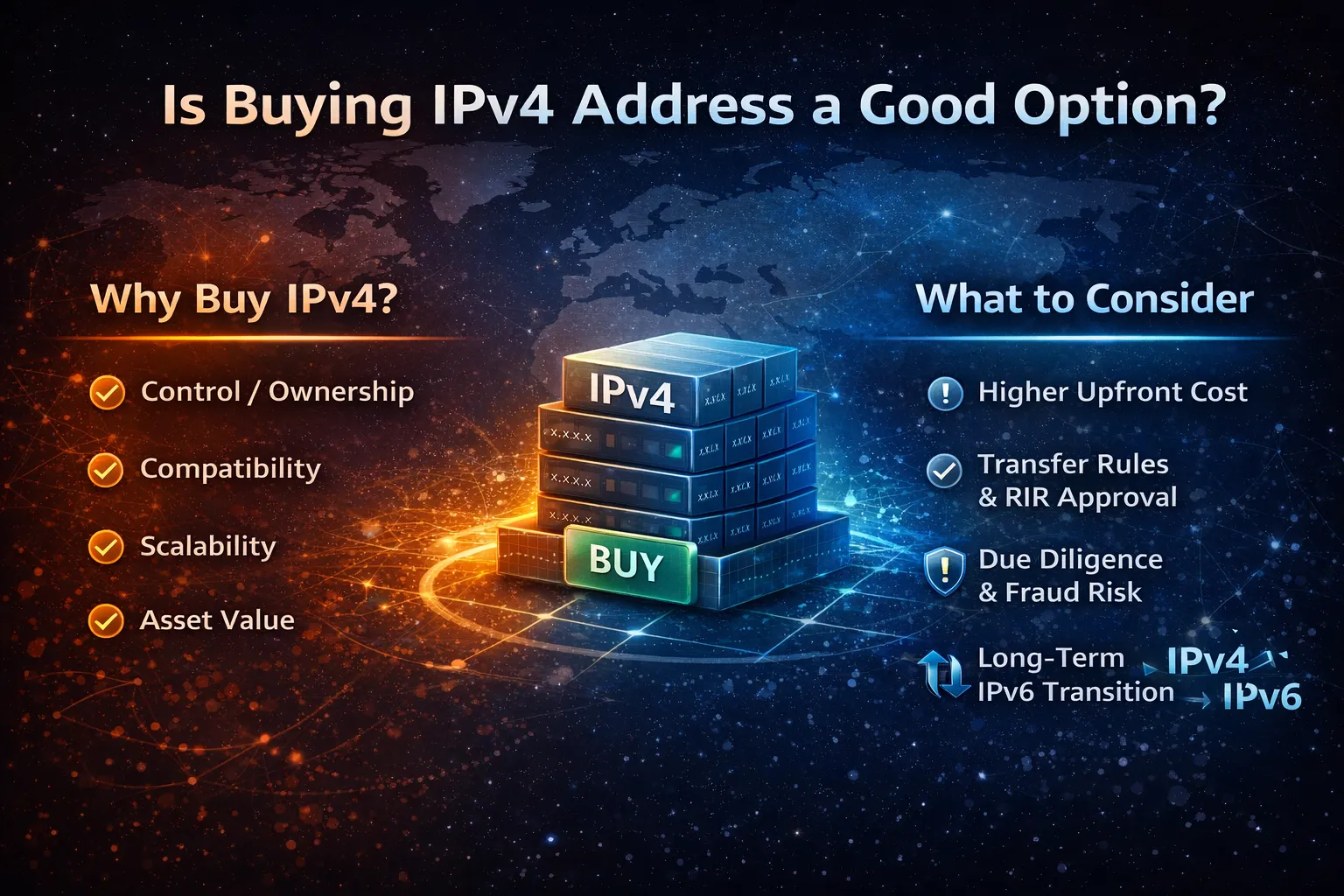
Buying IPv4 address space can be a good option, but it depends on your organization’s goals, budget, and long-term infrastructure strategy. In today’s post-exhaustion market, IPv4 is no longer a routine technical resource that can be obtained easily from large free pools. It is a scarce operational asset that often has to be acquired through policy-governed transfers or secondary market transactions.
For some businesses, buying IPv4 is the right choice because it provides long-term control and strategic certainty. For others, leasing may be more suitable because it offers flexibility and lower upfront cost. The right answer depends on how critical public IPv4 is to your business and how you want to manage that dependency over time.
What Does Buying IPv4 Actually Mean?
Buying IPv4 usually means acquiring registered IPv4 address resources through a transfer process rather than receiving newly created space. In practical terms, the buyer is securing long-term control of an existing address block that has already been issued within the Internet number resource system.
To understand why this matters, it helps to revisit what an IPv4 address is and why these addresses now carry both operational and financial significance.
Why Buying IPv4 Can Be a Good Option
1. Long-Term Control
One of the strongest reasons to buy IPv4 is long-term control. If your organization expects to rely on public IPv4 for years, buying can reduce uncertainty compared with depending on temporary access through leasing. It may be especially useful for enterprises, hosting platforms, and service providers with sustained infrastructure needs.
2. Strategic Certainty
Buying can also provide more predictable long-term planning. Instead of worrying about lease renewal, reallocation pressure, or needing to renegotiate access later, the organization can incorporate the IPv4 block directly into its broader network strategy.
3. Enterprise Asset Value
In many cases, buying makes sense because IPv4 now carries real strategic value. Some organizations increasingly evaluate long-term enterprise value in IPv4 assets, especially where public address space remains essential for customer reach, service delivery, and future growth.
When Buying May Not Be the Best Option
1. High Upfront Cost
Buying IPv4 usually requires a significant upfront capital commitment. For businesses that want to preserve cash or avoid committing too much capital to address resources, leasing may be more attractive.
2. Changing Operational Needs
If your IPv4 needs are temporary, uncertain, or likely to change, buying may be less efficient than leasing. An organization with short-term deployment needs or transitional infrastructure may not benefit from permanent acquisition.
3. Governance Exposure Still Exists
Buying IPv4 does not remove all structural risk. As some infrastructure analysts argue, the buyer is not necessarily gaining absolute sovereign property in the way many assume. This is part of the broader concern around registry-layer risk in IPv4 ownership, where continued use still depends on governance and registry systems.
Buying vs Leasing IPv4
The key difference is long-term control versus temporary access. Buying usually gives the organization long-term operational control over the address block, while leasing provides a defined-term right to use the space. Leasing may be better for lower upfront cost and flexibility, while buying may be better for long-term certainty.
This is why “good option” does not have a universal answer. Buying is a good option if your business needs stability and long-term use. Leasing is a good option if your business values flexibility, cash preservation, or shorter time horizons.
Questions to Ask Before Buying IPv4
How long will we need the space?
If your need is long term, buying may make more sense. If it is short term or transitional, leasing may be the better option.
Can we justify the upfront capital?
Buying requires more immediate capital. Organizations should compare this with the expected duration of use and whether recurring lease payments would cost more over time.
Do we understand the policy environment?
Safe buying also requires understanding how IP asset ownership and number resource policy affect the transaction. The market is shaped by transfer rules, registry procedures, and broader governance frameworks, not just by price alone.
Is the block operationally clean?
A clean and usable block is more valuable than one with spam, abuse, or blacklisting history. Pricing should never be assessed without considering block reputation.
Why the Answer Depends on Your Business Model
For a hosting company, data center, ISP, or cloud operator, buying may be a stronger long-term option because IPv4 remains closely tied to revenue-generating infrastructure. For a company with more limited public-facing network dependence, leasing may be enough.
This is also why some market observers treat IPv4 as a form of capital rather than just technical inventory. As IPv4 exhaustion and governance consequences continue to shape the market, buying can make sense for organizations that want to secure a scarce and operationally important resource for the long term.
The Bigger Strategic Debate
The question of whether buying IPv4 is a good option also ties into a larger market debate. If IPv4 still carries significant operational value, then buying can be a rational strategic move. If your organization expects IPv6 to eliminate the need for IPv4 very quickly, then buying may look less attractive. That is one reason the broader IPv4 assetization debate remains so relevant in 2026.
Conclusion
Buying IPv4 can be a good option if your organization needs long-term control, strategic certainty, and reliable access to public address space. It may be especially attractive for businesses whose infrastructure depends heavily on IPv4 and who see address space as an important long-term asset. However, it is not the best option for everyone. Leasing may be more suitable for organizations that value flexibility, lower upfront cost, or shorter-term access. The best decision depends on your time horizon, capital structure, and how central IPv4 remains to your operational future.
Read More: Buy IPv4 Address
Read More: Leasing vs Buying IPv4 Address
Frequently Asked Questions (FAQ)
1. Is buying IPv4 a good option for businesses?
It can be, especially for businesses that need long-term control and stable access to public IPv4 resources.
2. When is buying better than leasing?
Buying is usually better when the need is long term and the organization wants more strategic certainty rather than temporary access.
3. Is buying IPv4 risky?
It can carry governance, policy, and operational risks if the buyer does not understand the transfer framework or the quality of the block being acquired.
4. Why do companies still buy IPv4 if IPv6 exists?
Because many networks, services, and customer environments still depend heavily on IPv4, and that demand has not disappeared.
5. What should I check before buying IPv4?
You should check your real business need, the policy framework, the seller’s legitimacy, the block’s reputation, and whether buying truly fits your long-term strategy.