
Why Renewal Continuity Is the Most Critical Factor in IP Leasing Agreements
 Published:Last Updated: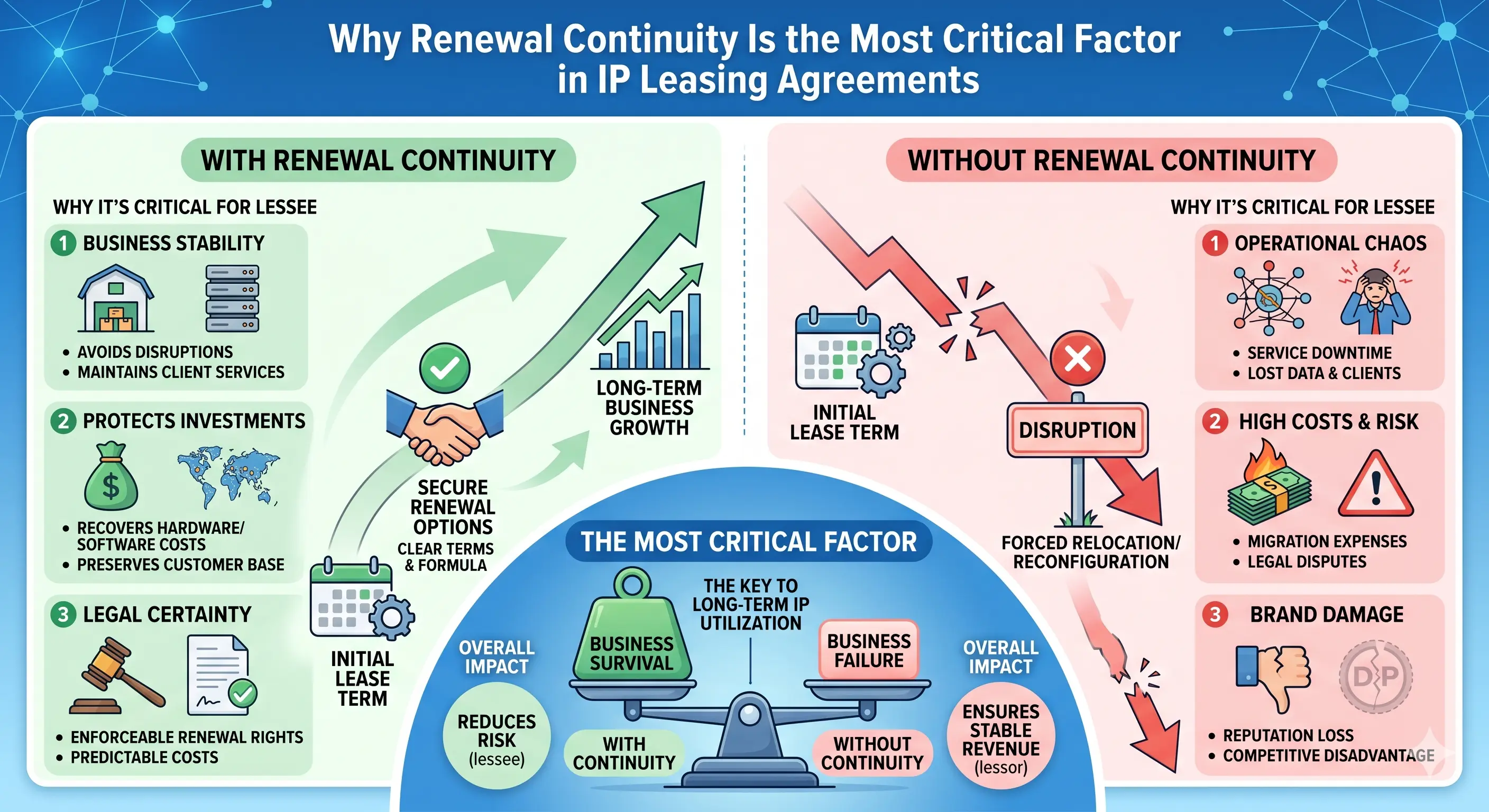
Table of Contents
- Introduction: The Hidden Risk Inside IP Leasing Agreements
- Why IP Leasing Is No Longer Just a Technical Decision
- The Overlooked Threat: Renewal Continuity Failure
- What Happens When IP Addresses Are Reclaimed Overnight
- Business Continuity Risk: The Silent Infrastructure Killer
- Financial Liability Exposure in IP Leasing Agreements
- Why “Ownership Illusion” Is a Dangerous Assumption
- How Enterprise Networks Collapse Without Warning
- Renewal Continuity as a Strategic Security Layer
- How LARUS Reduces IPv4 Leasing and Continuity Risk
- Building a Resilient IP Strategy for the AI & Cloud Era
- Final Thoughts: From Risk Awareness to Strategic Action
- FAQ
Introduction: The Hidden Risk Inside IP Leasing Agreements
Most enterprises treat IP Leasing Agreements as a procurement or cost-optimization exercise.
They negotiate pricing, check availability, and assume continuity is guaranteed.
But beneath this surface-level simplicity lies a critical vulnerability that many organizations fail to evaluate:
Renewal continuity risk — the possibility that your IP addresses may not be available when your lease expires or is disrupted.
In today’s cloud-first, AI-driven infrastructure landscape, this is not a theoretical concern.
It is a business continuity threat with direct operational and financial consequences.
Why IP Leasing Is No Longer Just a Technical Decision
IP addresses are no longer just network identifiers.
They are now:
- Core infrastructure assets for SaaS platforms
- Authentication anchors for enterprise systems
- Routing identities for global traffic delivery
- Compliance-linked digital resources
- Security trust signals for clients and APIs
This means IP Leasing Agreements directly influence:
- Uptime reliability
- Cybersecurity posture
- Global service accessibility
- Brand trust and deliverability
Yet many organizations still treat them as interchangeable utilities.
That assumption is increasingly dangerous.
The Overlooked Threat: Renewal Continuity Failure
The most underestimated risk in IP leasing is not price or performance.
It is renewal continuity failure.
This occurs when:
- A provider refuses renewal
- IP space is reallocated
- Contract terms change unexpectedly
- Regional registry conditions shift
- Ownership rights are not guaranteed
In such cases, enterprises may lose access to critical IP resources without sufficient transition time.
This is where operational disruption begins.
What Happens When IP Addresses Are Reclaimed Overnight
When IP resources are withdrawn or not renewed, enterprises face immediate cascading failures:
- VPN and remote access systems break
- Customer-facing applications go offline
- Email deliverability collapses
- DNS and routing configurations fail
- Cloud services lose stable identity mapping
Unlike software downtime, this is not a restart issue.
It is a structural network identity collapse.
Recovery often requires:
- Emergency migration
- Emergency IP procurement at premium pricing
- Reconfiguration of global systems
- Potential loss of customer trust and SLA breaches
For large enterprises, the exposure can scale into multi-million-dollar operational disruption events.
Business Continuity Risk: The Silent Infrastructure Killer
Most IT disaster recovery plans focus on:
- Servers
- Data
- Applications
- Storage
But they often ignore IP layer dependency.
Yet IP continuity is foundational to:
- Traffic routing
- System authentication
- Service discovery
- Multi-region synchronization
Without stable IP continuity, even fully redundant systems can fail.
This is why IP Leasing Agreements must be evaluated as continuity contracts — not procurement contracts.
Financial Liability Exposure in IP Leasing Agreements
The financial risks of poor IP leasing structures are often indirect but severe:
- SLA penalties from downtime
- Revenue loss from service interruption
- Customer churn due to instability
- Emergency infrastructure replacement costs
- Regulatory exposure in critical industries
In high-scale environments, IP instability can trigger liability chains exceeding operational expectations.
The core issue is not just loss of IP — it is loss of predictable infrastructure identity.
Why “Ownership Illusion” Is a Dangerous Assumption
A common misconception in IP Leasing Agreements is the belief that:
“Once leased, IP resources are functionally permanent.”
This is false.
In reality:
- IP allocation is governed by registry-level policies
- Providers maintain ultimate control of reassignment
- Contract enforcement varies across jurisdictions
- Renewal terms are not always guaranteed long-term
This creates what is known as the ownership illusion risk.
Enterprises assume control they do not fully possess.
How Enterprise Networks Collapse Without Warning
When renewal continuity breaks, failure is often:
- Sudden
- Silent
- System-wide
There is no gradual degradation.
Instead, organizations experience:
- Instant routing blackouts
- Authentication failures across services
- API breakdowns across ecosystems
- Cascading downtime across dependent systems
The most dangerous part?
These failures often occur during peak business activity or scaling events, when dependency on IP stability is highest.
Renewal Continuity as a Strategic Security Layer
Forward-looking enterprises now treat renewal continuity as:
A cyber-infrastructure security layer, not a contract clause.
This includes:
- Multi-year continuity assurance
- Provider redundancy strategies
- IP portfolio diversification
- Structured leasing governance
- Risk-controlled migration pathways
The goal is simple:
Ensure that IP identity is never a single point of failure.
How LARUS Reduces IPv4 Leasing and Continuity Risk
In the modern IPv4 scarcity environment, structured leasing requires more than availability.
It requires continuity engineering.
This is where LARUS plays a strategic role.
LARUS helps enterprises:
- Secure structured IPv4 leasing frameworks
- Reduce exposure to sudden IP withdrawal risks
- Improve long-term renewal predictability
- Stabilize global routing architecture
- Maintain operational continuity across infrastructure layers
Instead of treating IP leasing as transactional supply, LARUS focuses on continuity-first IP lifecycle management.
This approach helps enterprises reduce:
- Infrastructure uncertainty
- Renewal disruption risk
- Dependency fragmentation
And most importantly:
It strengthens long-term operational resilience in IP Leasing Agreements.
Building a Resilient IP Strategy for the AI & Cloud Era
As enterprises adopt AI workloads, multi-cloud architecture, and edge computing, IP dependency is increasing.
A resilient strategy now requires:
- Predictable IP lifecycle planning
- Continuity-guaranteed leasing structures
- Provider risk diversification
- AI-aware traffic architecture design
- Governance over IP renewal cycles
Without these, infrastructure becomes reactive rather than strategic.
Final Thoughts: From Risk Awareness to Strategic Action
The core mistake enterprises make is assuming IP leasing is stable by default.
It is not.
In reality, IP Leasing Agreements are only as strong as their renewal continuity design.
And when continuity fails, everything built on top of it fails faster.
Organizations that ignore this risk are not just exposed technically — they are exposed operationally and financially.
FAQ
1. What are IP Leasing Agreements?
IP Leasing Agreements are contracts that allow organizations to rent IPv4 or IPv6 address space for use in networking, hosting, and infrastructure operations.
2. Why is renewal continuity so important in IP leasing?
Because without guaranteed renewal continuity, organizations risk losing access to critical IP resources, leading to downtime and infrastructure disruption.
3. What happens if IP addresses are not renewed?
Systems relying on those IPs may fail, including email services, APIs, VPNs, DNS routing, and customer-facing applications.
4. Can IP leasing impact business continuity?
Yes. IP instability can directly affect uptime, service delivery, and global infrastructure reliability.
5. How does LARUS help with IP leasing risk?
LARUS provides structured IPv4 leasing solutions designed to improve continuity, reduce renewal uncertainty, and support long-term infrastructure stability.