

How LARUS Ensures IPv4 Address Continuity In a Scarce Market
 Published:Last Updated: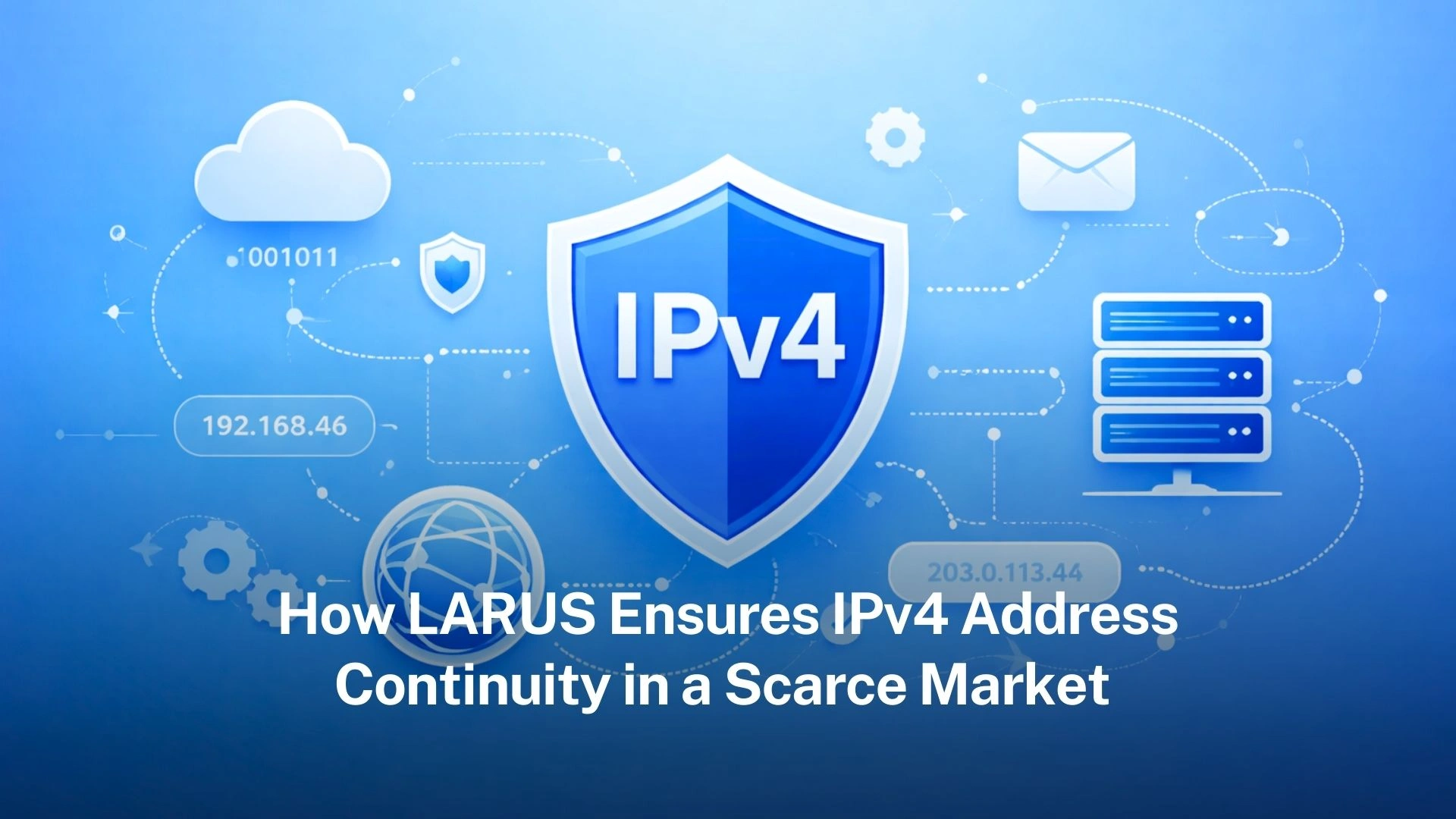
Table of Contents
- IPv4 scarcity and the continuity challenge
- On-demand leasing for rapid address access
- Address management and registry compliance
- Protecting operational continuity in dynamic environment
- Case example: strategic IPv4 continuity
- Supporting address reputation and network trust
- Continuous support and strategic advisory
- Why continuity matters beyond scarcity
- Conclusion: continuity as strategic infrastructure
- Frequently asked questions
In a world where IPv4 addresses are scarce, LARUS helps organisations secure reliable address continuity through on-demand leasing, management and strategic services.
-
LARUS’s global leasing platform and expert support enable rapid access to IPv4 resources without lengthy procurement delays.
-
A comprehensive approach to address management, registry compliance and scalability helps enterprises maintain resilient network infrastructure.
IPv4 scarcity and the continuity challenge
IPv4 addresses — the numerical identifiers that make internet connectivity possible — were officially exhausted years ago, meaning the free pool for allocation by the Internet Assigned Numbers Authority and regional registries no longer exists. This scarcity has made acquiring new IPv4 resources increasingly difficult for enterprises facing growth demands such as cloud deployments, content delivery and global connectivity. Organisations that cannot secure enough IPv4 space risk service degradation, diminished reachability, or costly delays in infrastructure expansion.
On-demand leasing for rapid address access
One of LARUS’s core offerings is on-demand IPv4 leasing that accelerates access to address space when organisations need it most. In contrast to traditional procurement — which often requires lengthy negotiations, registry interactions and bureaucratic approvals — leasing through LARUS can provide address blocks ready for deployment within 24 hours. This responsiveness is especially valuable for enterprises launching new services or scaling rapidly in competitive markets where time-to-deployment matters.
Address management and registry compliance
Maintaining continuity goes beyond simply securing a block of addresses; robust governance of those resources matters equally. LARUS supports enterprises with complete lifecycle management of address holdings, including advisory around Regional Internet Registry (RIR) compliance and membership matters. The company’s team has deep experience navigating the varied policies of registries such as APNIC, ARIN and RIPE NCC, helping clients avoid procedural pitfalls and costly delays. However, transfers and registrations are policy-driven and can involve documented requirements: for example, ARIN notes that specified-recipient transfers require the recipient to demonstrate need under policy and may require a resource request process.
Protecting operational continuity in dynamic environments
In an era where digital services expand across cloud platforms, distributed data centres and diverse user bases, address continuity is also about flexibility. LARUS’s IPv4 solutions cater to this need by offering scalable leasing options that organisations can adjust as demand changes. Whether an enterprise needs additional blocks for a short-term campaign or long-term capacity planning, the ability to smooth address supply through leasing helps maintain uninterrupted services and accommodates fluctuating requirements without arduous administrative overhead.
Case example: strategic IPv4 continuity
Organisations that partner with LARUS often use a blend of leasing and permanent address acquisition as part of a broader connectivity strategy. One documented example involved a global technology company that secured more than 300,000 IPv4 addresses as part of a comprehensive long-term plan. By combining both leased and purchased address holdings, the company was able to expand its geographic presence and prevent service disruptions that would have otherwise arisen from capacity limits. This dual approach enhanced their ability to deliver cloud and network services without interruption.
Supporting address reputation and network trust
Ensuring continuity also involves maintaining the reputation and cleanliness of an organisation’s address space. Addresses that have been associated with abuse or blacklisting can harm email deliverability, connectivity and security posture. LARUS emphasises thorough validation and management of address holdings, helping enterprises avoid reputational issues that could undermine continuity and trust in their networks.
Continuous support and strategic advisory
Address continuity is both technical and strategic. LARUS supplements its leasing offerings with ongoing support, addressing questions that range from deployment timetables to compliance documentation. For enterprises without dedicated internet number resource teams, this external expertise reduces risk and accelerates project timelines.
Why continuity matters beyond scarcity
IPv4 continuity is not only a reaction to scarcity; it is a foundation for predictable infrastructure planning. Organisations that secure reliable IPv4 pathways can ensure stable operations for legacy systems, progressive IPv6 transitions, and hybrid network architectures that span multiple environments and geographies.
Conclusion: Continuity as strategic infrastructure
In a landscape where IPv4 scarcity shapes decision-making across industries, LARUS provides a model for ensuring address continuity in ways that are practical, compliant and scalable. Through rapid leasing, comprehensive management and registry expertise, the company helps enterprises maintain stable network operations while accommodating growth and change.
Frequently asked questions
-
Why is IPv4 address continuity important in today’s internet?
Because the free pool of IPv4 addresses is depleted, enterprises must secure address continuity to maintain reachability, service delivery and network growth. -
How does LARUS speed up access to IPv4 addresses?
LARUS's on-demand leasing service can provide IPv4 blocks ready for deployment within 24 hours, bypassing lengthy registry procurement cycles. -
Does LARUS help with compliance and registry processes?
Yes. LARUS provides support for registry compliance, address management and RIR policy navigation to ensure stable, compliant use of address resources. -
Can leased IPv4 addresses support global operations?
Yes. LARUS offers geolocated IPv4 addresses from a diverse pool, enabling enterprises to support connectivity across regions. -
What additional support does LARUS offer beyond leasing?
LARUS provides ongoing support and advisory services, assisting organisations with address deployment strategies, compliance documentation and long-term planning.