


Factors that Affect IPv4 Address Pricing
 Published:Last Updated:
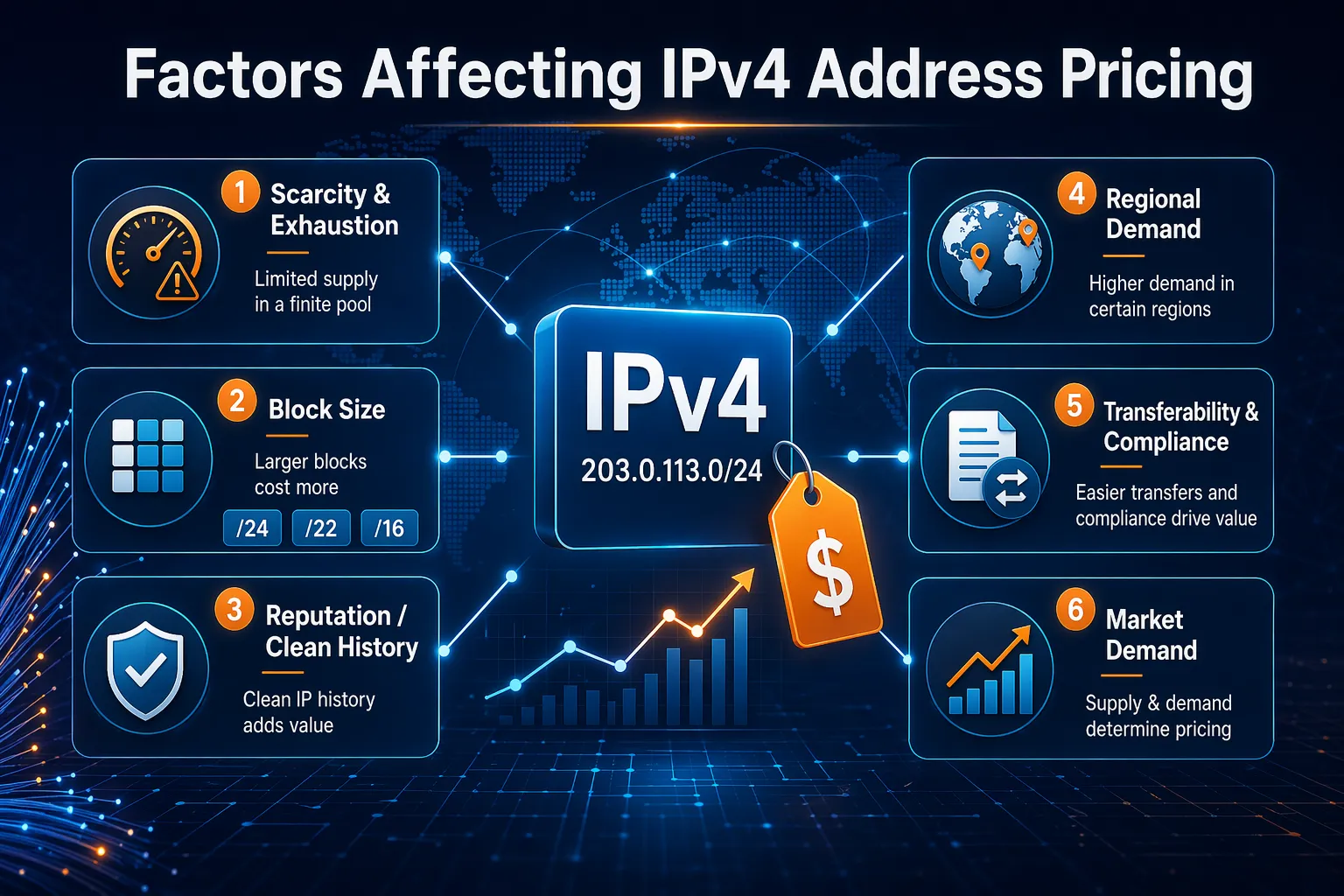
IPv4 address pricing is influenced by several market and operational factors. In the early Internet era, organizations could often obtain IPv4 resources more easily through registry allocation. Today, that is no longer the case. Because public IPv4 space is limited, pricing has become closely tied to scarcity, transfer structure, demand patterns, and the practical quality of the address block.
For buyers, sellers, and organizations planning long-term IP strategy, understanding what affects IPv4 address pricing is important. Price is not determined by quantity alone. It is shaped by how useful, clean, transferable, and strategically valuable the address space is in the real market.
Why IPv4 Address Pricing Matters
IPv4 address pricing matters because public IPv4 remains operationally necessary across hosting, cloud services, enterprise infrastructure, and customer-facing networks. Even though IPv6 exists, demand for IPv4 continues in many real-world environments. As a result, pricing affects infrastructure planning, budgeting, expansion decisions, and the value of existing address holdings.
In a post-exhaustion market, the price of IPv4 has become a practical signal of scarcity, utility, and market confidence.
Main Factors That Affect IPv4 Address Pricing
1. Scarcity of Available IPv4 Space
The most fundamental factor is scarcity. IPv4 has a limited address space, and freely available pools have long been exhausted in most regions. Because demand still exists while supply is constrained, the remaining transferable or leasable IPv4 resources carry economic value. The tighter the market feels, the more upward pressure pricing can face.
2. Block Size
Block size is one of the clearest pricing drivers. In many market conditions, smaller blocks such as /24 to /20 can command stronger per-IP pricing because they are easier for a wider range of buyers to absorb. Larger blocks may carry greater total value, but they can attract a narrower buyer pool and may trade at a lower per-address rate. Recent market reporting continues to note this gap between large-block and small-block behavior.
3. Regional Policy and Transfer Environment
Pricing is also shaped by the region in which the address block sits and the transfer policies that apply to it. Different Regional Internet Registries have different rules, administrative requirements, and market conditions. These differences can affect transaction speed, buyer demand, and how attractive a block is in practice. In some markets, tighter supply conditions may support higher pricing than in others.
4. Reputation and Cleanliness of the Address Block
An IPv4 block with a clean operational history is generally more desirable than one associated with spam, abuse, or blacklisting. Reputation can influence both transfer and lease value because buyers and lessees care about how easily the addresses can be used in live production environments. A block that is technically valid but operationally “dirty” may be worth less or may require more remediation effort before deployment.
5. Sale vs Lease Structure
The transaction structure affects pricing too. A sale usually reflects the long-term capital value of the address resource, while a lease reflects temporary usage value over time. In recent market reporting, leasing has appeared more stable than purchase pricing, with lease rates behaving more like a recurring utility cost while transfer prices move more sharply by block size.
6. Market Timing and Buyer Behavior
IPv4 pricing is not static. It changes with market timing, buyer sentiment, and the number of active sellers. If more sellers enter the market at once or if large buyers slow their purchases, prices may soften. If demand rises for specific block sizes or regions, prices may strengthen. This is why organizations should assess current market conditions instead of relying only on older benchmark assumptions.
Why Smaller Blocks and Larger Blocks Behave Differently
Smaller blocks often remain firmer because more organizations can realistically buy or lease them. Larger blocks require bigger capital commitments and suit a more limited pool of buyers. That means larger blocks may experience more pricing pressure even when overall IPv4 demand remains strong. This difference explains why total value and per-IP value do not always move in the same direction.
How Governance and Infrastructure Reality Affect Pricing
IPv4 pricing is not only a matter of supply and demand. It also reflects deeper governance and infrastructure realities. Address transfer rules, scarcity across regions, and the way organizations gain or retain access to number resources all influence the market. This is why some analysts argue that pricing should be understood not just as a commercial figure, but as a sign of broader structural constraints in Internet infrastructure.
What Buyers and Sellers Should Watch
For Buyers
Buyers should look beyond headline price. A lower-cost block may not be the best choice if its reputation is poor, its region is difficult to work with, or its size does not fit long-term needs. Safety, usability, and future flexibility matter just as much as the quoted number.
For Sellers
Sellers should understand how block size, cleanliness, timing, and region influence value. A well-prepared block with clear documentation and a strong operational profile may command a better outcome than a poorly prepared sale attempt.
For Lessors
Organizations considering leases should assess not only the monthly rate but also renewal stability, contract structure, and the ongoing operational suitability of the block. Lease pricing may appear predictable, but long-term value depends on more than the monthly figure alone.
Conclusion
Several factors affect IPv4 address pricing, but the most important are scarcity, block size, regional policy environment, block reputation, transaction structure, and current market timing. In a post-exhaustion market, IPv4 pricing is shaped by both technical utility and broader market behavior. Understanding these factors helps organizations make better decisions whether they are buying, selling, leasing, or planning the long-term use of their address resources.
Read More: Understanding IPv4 Subnet Pricing
Read More: Current IPv4 Lease Rates: What to Expect in 2026
Frequently Asked Questions (FAQ)
1. What is the biggest factor affecting IPv4 address pricing?
Scarcity is the biggest factor, but pricing is also shaped by block size, region, reputation, and whether the transaction is a sale or a lease.
2. Why do smaller IPv4 blocks sometimes cost more per address?
Smaller blocks often appeal to a broader range of buyers and therefore can hold stronger per-IP pricing than large blocks.
3. Does the region affect IPv4 pricing?
Yes. Regional policy rules, transfer conditions, and supply-demand balance can affect how attractive and valuable a block is.
4. Can a block’s reputation change its value?
Yes. Blocks associated with spam, abuse, or blacklisting may be less desirable and therefore less valuable than clean blocks.
5. Is lease pricing the same as purchase pricing?
No. Lease pricing reflects temporary usage value over time, while purchase pricing reflects longer-term capital value through a transfer or sale.