
Can Your Business Survive Losing Its IP Addresses?
 Published:Last Updated:
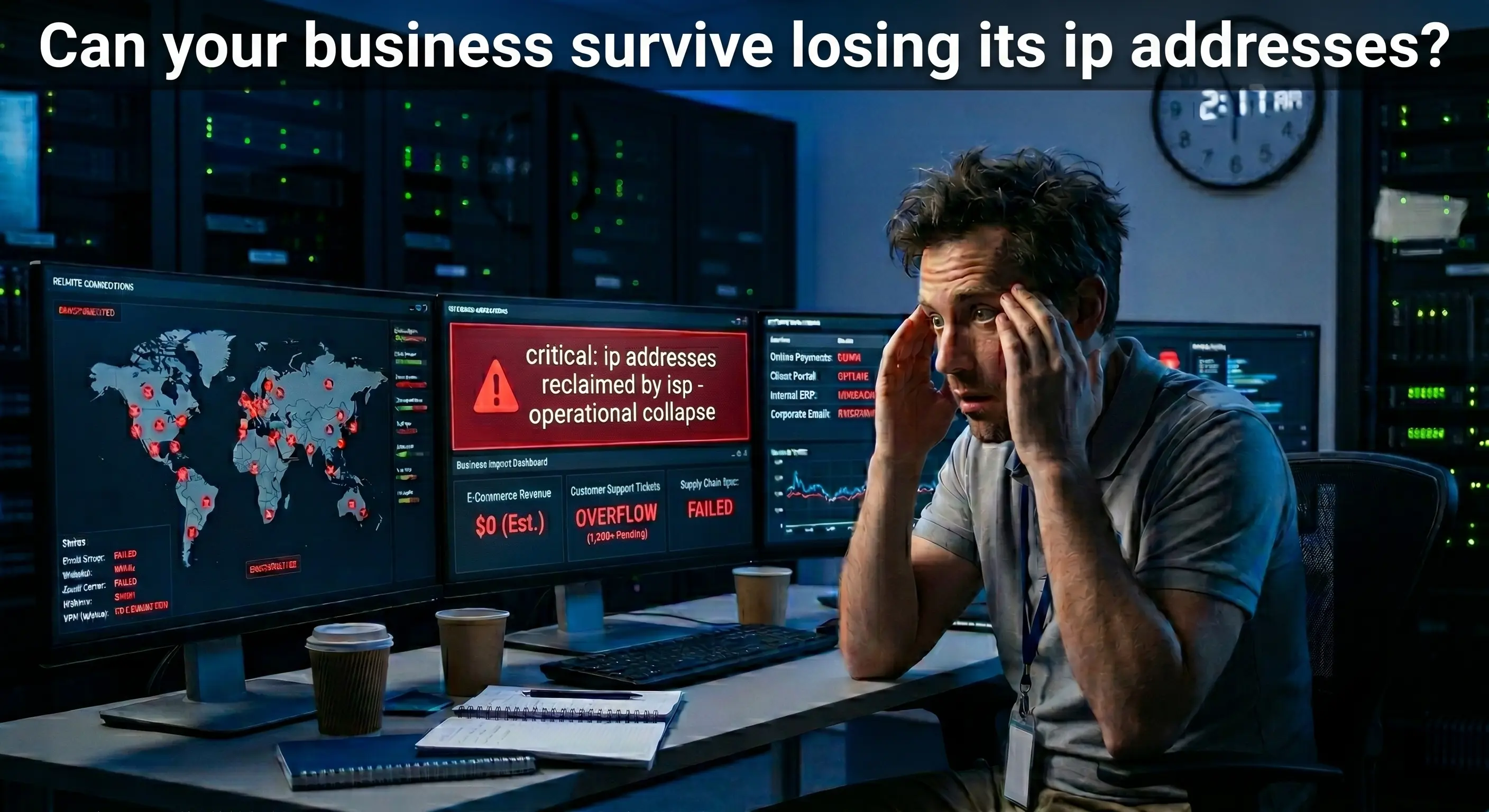
Table of Contents
- Understanding the IP Leasing Ecosystem
- The Real Risk: Renewal Continuity Failure
- Hidden Legal and Contractual Exposure
- The Illusion of IP Ownership
- How IP Loss Impacts Business Operations
- Why LARUS Is Structurally Different
- Risk Management vs Cost Optimization
- FAQ
Understanding the IP Leasing Ecosystem
Most modern businesses rely on leased IPv4 addresses to power their digital infrastructure. However, what is often overlooked is how layered and indirect the ownership structure actually is.
A typical structure involves:
- Regional Internet Registry (RIR)
- Upstream allocation holders
- Leasing providers or intermediaries
- End-user businesses
This multi-layer model means businesses are not directly connected to the original allocation source. Instead, they depend on several intermediaries for continued access.
The result is a system where stability depends not only on usage—but also on upstream decisions.
The Real Risk: Renewal Continuity Failure
The most significant risk in IP leasing is not price—it is renewal continuity.
Renewal continuity refers to the ability to retain the same IP resources without interruption over time.
Failure can occur due to:
- Policy changes at registry level
- Upstream allocation adjustments
- Contract non-renewal conditions
- Provider-side structural changes
When renewal continuity fails, businesses may face unexpected IP loss and forced migration.
In practice, this can result in sudden service disruption if no fallback planning exists.
Hidden Legal and Contractual Exposure
IP leasing agreements often include operational and legal responsibility clauses that define how IPs must be used and maintained.
In some cases, contracts may include:
- Strict compliance obligations
- Termination rights under specific conditions
- Limited compensation clauses
- Liability exposure tied to misuse or abuse
These structures are standard in infrastructure services, but they require careful understanding from business operators.
The key risk is not the clause itself, but how little visibility many organizations have into its implications.
The Illusion of IP Ownership
Many businesses assume that leasing IP addresses is similar to owning them. In reality, leasing typically provides usage rights, not ownership.
True ownership would require:
- Direct registry-level allocation
- Full control over renewal decisions
- Independent governance of IP resources
Without these elements, IP resources remain dependent on upstream structures.
This creates a condition where businesses operate with functional access—but not structural control.
How IP Loss Impacts Business Operations
When IP addresses are lost or revoked, the impact is immediate and operationally significant.
Typical consequences include:
- Website or application downtime
- API connection failures
- Email delivery disruption
- Firewall and security reconfiguration
- SEO ranking fluctuations for web services
Unlike gradual performance degradation, IP loss can trigger sudden system-wide failure.
This is why continuity planning is critical in enterprise environments.
Why LARUS Is Structurally Different
LARUS is designed to address the structural weaknesses commonly found in traditional IP leasing models.
Instead of relying on fragmented multi-layer dependencies, LARUS focuses on:
- More stable allocation structures
- Improved renewal continuity planning
- Reduced dependency complexity
This approach helps enterprises maintain more predictable infrastructure behavior over time.
The emphasis is not on short-term leasing efficiency, but on long-term operational stability.
Risk Management vs Cost Optimization
Many organizations prioritize lower-cost IP leasing options to optimize budgets. However, cost alone does not reflect operational risk.
Lower-cost models may introduce:
- Less predictable renewal conditions
- Higher dependency on intermediaries
- Greater exposure to infrastructure changes
By contrast, a risk-managed approach prioritizes stability, continuity, and long-term resilience.
In enterprise environments, infrastructure continuity often has greater financial impact than short-term pricing differences.
Final Question: Are You Prepared?
If your IP resources were no longer available tomorrow, how quickly could your business recover?
For many organizations, the answer depends on how well continuity has been planned—not just how well costs have been optimized.
LARUS focuses on helping businesses strengthen this foundation, ensuring that IP infrastructure remains stable, predictable, and aligned with long-term operational needs.
Frequently Asked Questions (FAQ)
1. What happens if an IP provider refuses renewal?
Businesses may lose access to IP addresses, requiring migration and potentially causing service disruption.
2. Do companies own leased IP addresses?
No. Leasing typically provides usage rights, not full ownership or registry control.
3. What is renewal continuity risk?
It is the risk of losing access to IP addresses due to non-renewal or upstream allocation changes.
4. How does IP loss affect business operations?
It can cause downtime, email failure, API disruption, and potential SEO impact for online services.
5. How does LARUS help reduce IP leasing risk?
LARUS focuses on improving structural stability and renewal continuity to support long-term infrastructure reliability.